
Straight-Line Depreciation Method: Formula, Example and Excel (2025)
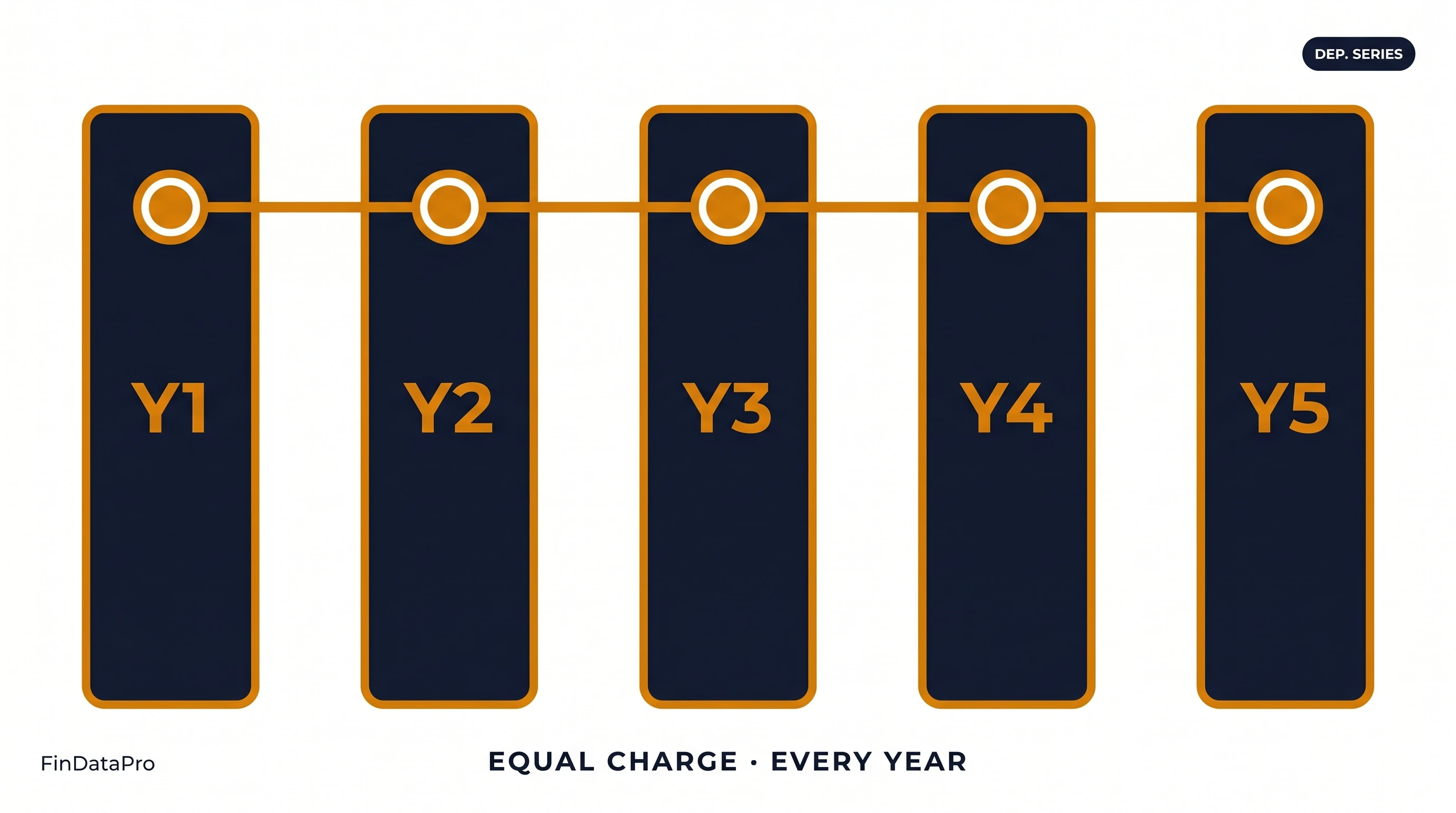
Master straight-line depreciation with the SLN formula, a full worked example, Excel function, IAS 16 guidance, and the deferred tax impact most guides ignore.

ACA | FMVA® | 19 Years in Finance
Most accountants use straight-line depreciation without ever asking whether they should. It is the default choice, the simplest calculation, and the easiest to explain in audit. For many assets, it is also the correct answer.
For others, it produces a P&L that does not reflect how the asset actually wears out: and a closing book value in Year 3 that is materially higher than the asset's recoverable amount. The issue is not that straight-line is wrong. The issue is applying it to assets where the economic reality is front-loaded depreciation, and calling it conservative.
Understanding the straight-line depreciation method properly means knowing not just the formula, but when it fits, what it does to your deferred tax position, and what IAS 16 actually requires of you when you pick it.
Table of Contents {#toc}
- What Is Straight-Line Depreciation
- The SLN Formula: Anatomy and Variables
- Step-by-Step Worked Example: GCC Context
- Year-by-Year Depreciation Schedule
- Excel Implementation: The =SLN() Function
- IAS 16 Compliance: What the Standard Requires
- When Straight-Line Is the Right Choice (and When It Is Not)
- Deferred Tax: The Part Nobody Explains
- Frequently Asked Questions
- Conclusion
What Is Straight-Line Depreciation {#what-is-sln}
Straight-line depreciation allocates an equal charge to each period of an asset's useful life. The annual charge does not change. It does not depend on how much the asset was used in that year. It does not respond to market value movements. It is a systematic allocation of the depreciable amount: cost less residual value: spread evenly across the asset's estimated useful life.
Under IAS 16.62, straight-line is one of the three methods explicitly named as appropriate when the method reflects the pattern of economic benefit consumption. The other two are diminishing balance and units of production. The standard does not rank them. It requires you to select the one that matches how the asset loses its economic value.
For assets where the loss of value is time-driven and roughly linear: an office building, a long-term lease improvement, certain categories of furniture and fixtures: straight-line is the correct technical answer. The equal charge across periods matches the equal benefit consumed in each period.
The problem is not the method. The problem is applying it by default, without testing whether the asset actually loses value evenly over time.
The SLN Formula: Anatomy and Variables {#formula}
The formula has three components. Each one involves an accounting estimate that must be reviewed annually.
Annual Depreciation = (Cost - Salvage Value) / Useful Life
Cost: The total amount paid to bring the asset to its intended condition and location. Under IAS 16.16, this includes purchase price (net of trade discounts), any import duties and non-refundable purchase taxes, and directly attributable costs such as delivery, installation, site preparation, and initial testing. It does not include general overheads, administration costs, or costs incurred after the asset is in use.
Salvage value: The estimated amount recoverable when the asset is derecognised at the end of its useful life: after deducting disposal costs. IAS 16.51 requires this estimate to be reviewed at each financial year-end. In practice, many entities set salvage value to zero or to a nominal amount and do not revisit it. That is not compliant with IAS 16, and it produces a depreciable amount that is higher than the economic reality.
Useful life: The period over which the asset is expected to be available for use by the entity. This is not the same as the physical life of the asset, which may be much longer. Useful life is the entity's best estimate of how long the asset will serve its intended purpose: factoring in the entity's asset management policy, expected wear-out rates, and technological obsolescence. IAS 16.61 requires this estimate to be reviewed at every year-end. Changes are applied prospectively as a change in accounting estimate under IAS 8.
Step-by-Step Worked Example: GCC Context {#worked-example}
A company vehicle purchased in Bahrain for use in the operations of a regional distribution company.
Asset details:
| Item | Value |
|---|---|
| Cost (purchase price + delivery + registration) | USD 35,000 |
| Estimated salvage value at end of year 5 | USD 5,000 |
| Estimated useful life | 5 years |
| Depreciable amount (cost - salvage) | USD 30,000 |
Annual depreciation:
(35,000 - 5,000) / 5 = USD 6,000 per year
The charge is USD 6,000 in Year 1. USD 6,000 in Year 5. Every year, the same amount. The book value declines in a straight line from USD 35,000 to USD 5,000 over 5 years.
Year-by-Year Depreciation Schedule {#schedule}
| Year | Opening Book Value (USD) | Depreciation Charge (USD) | Accumulated Depreciation (USD) | Closing Book Value (USD) |
|---|---|---|---|---|
| 1 | 35,000 | 6,000 | 6,000 | 29,000 |
| 2 | 29,000 | 6,000 | 12,000 | 23,000 |
| 3 | 23,000 | 6,000 | 18,000 | 17,000 |
| 4 | 17,000 | 6,000 | 24,000 | 11,000 |
| 5 | 11,000 | 6,000 | 30,000 | 5,000 |
The closing book value in Year 5 equals the salvage value estimate exactly. If the salvage value or useful life is revised during the asset's life, the remaining depreciable amount is recalculated and allocated over the revised remaining life from that point forward.
Excel Implementation: The =SLN() Function {#excel}
Excel's built-in SLN function returns the annual straight-line depreciation charge directly.
Syntax:
=SLN(cost, salvage, life)
Applied to the example:
=SLN(35000, 5000, 5) → 6000
The function always returns the same value regardless of the period argument: because straight-line charges are equal across all periods. This is a difference from =DB() and =DDB(), which require a period argument because their output changes year to year.
Building a full depreciation schedule:
The SLN function does not produce a multi-year table by itself. To build a complete schedule, set up a table with years as row labels and reference the function:
| Cell | Formula | Output |
|---|---|---|
| Annual charge (any year) | =SLN($B$2,$B$3,$B$4) | 6,000 |
| Opening BV Year 1 | =$B$2 | 35,000 |
| Opening BV Year N | =C[N-1] (prior closing BV) | Varies |
| Accumulated depreciation | =SLN($B$2,$B$3,$B$4)*A[row] | Varies by year |
| Closing BV | =Opening BV - Annual charge | Varies |
Where B2 = cost, B3 = salvage, B4 = useful life.
Lock the SLN arguments with absolute references ($) so they do not shift when the formula is copied down the table.
Partial-year depreciation:
SLN does not have a built-in partial-year argument. If an asset is acquired mid-year, calculate the partial charge manually:
First period charge = (Annual charge / 12) × months remaining in year
For a vehicle acquired in October with 3 months remaining: (6,000 / 12) × 3 = USD 1,500 in Year 1. The remaining 9 months of Year 1's charge carry into Year 6, making the total depreciation period 5 years and 9 months. Document the acquisition date and the apportionment method in the fixed asset register.
Building this manually takes time and leaves room for error: particularly when your asset register grows past 50 items and partial-year acquisitions accumulate across multiple accounting periods. DepreciationLab automates straight-line depreciation with full schedule output and partial-year handling built in, designed for finance professionals who need audit-ready schedules without formula maintenance. Try it at depreciationlab.org.
IAS 16 Compliance: What the Standard Requires {#ias16}
IAS 16 does not mandate straight-line. It requires the method to reflect the pattern of economic benefit consumption from the asset. Straight-line satisfies this requirement when the benefit from the asset genuinely flows evenly over its useful life: not as a default or as a convenience.
The three requirements that matter in every audit:
1. Method selection is not permanent. IAS 16.61 requires the depreciation method to be reviewed at least at each financial year-end. If the expected pattern of consumption has changed, the method must change. A change in method is a change in accounting estimate under IAS 8.38: applied prospectively, with the financial effect disclosed in the notes.
2. Useful life must be reviewed annually. The useful life estimate at the time of capitalisation is a starting point, not a conclusion. If the asset's remaining useful life changes, the remaining depreciable amount is spread over the revised remaining life from the date of the change. Retaining the original estimate without documented review is not compliant.
3. Residual value must be reviewed annually. The salvage value estimate affects the depreciable amount directly. An asset with a higher-than-estimated salvage value has a lower depreciable amount, and therefore a lower annual depreciation charge. Unrealistic residual value estimates: particularly USD 0 residual values applied to assets that clearly have scrap or resale value: overstate the depreciation charge and understate the closing book value.
The full text of IAS 16 is published by the IFRS Foundation at ifrs.org.
What audit teams look for:
In a GCC audit engagement, the questions most commonly directed at fixed asset depreciation are:
- Has the useful life been reviewed this year? (Show the documentation.)
- Has the residual value been reviewed? (Show the documentation.)
- Is the method consistent with prior years? If not, what changed?
- Does the method match the pattern of economic benefit consumption for this asset class?
"We've always done it this way" is not an answer. It is an invitation to a deeper review.
When Straight-Line Is the Right Choice (and When It Is Not) {#when-to-use}
Use straight-line when:
The asset delivers economic benefits evenly across its useful life. Office furniture. Leasehold improvements. Long-life industrial equipment with consistent, stable output. Buildings (for accounting purposes: separate from tax). Assets where the primary driver of useful life is the passage of time rather than physical usage or technological change.
Do not default to straight-line when:
The asset loses value rapidly in the first few years. Motor vehicles in the GCC depreciate sharply in the first two years of ownership: a vehicle worth USD 35,000 new may be worth USD 20,000 after 18 months: not USD 29,000. Applying straight-line produces a closing book value that overstates the recoverable amount, creating an impairment risk that may not surface until the vehicle is disposed of at a price below book.
Technology assets: IT equipment, servers, point-of-sale systems, specialised software: face a similar pattern. The economic benefit is concentrated in the first two to three years. After that, the asset is still in use but delivering less value, and often approaching replacement. DDB or WDV reflects this reality more accurately than straight-line.
Assets used in production, where wear tracks volume rather than time: a manufacturing machine that sits idle for six months delivers no economic benefit in those months. Straight-line charges depreciation regardless. Units of production does not.
The test is not "which method is simplest?" The test is "how does this asset actually lose its value?"
Deferred Tax: The Part Nobody Explains {#deferred-tax}
Straight-line depreciation for accounting purposes and the depreciation rate your tax jurisdiction allows are almost always different. That difference creates a temporary timing difference under IAS 12: and a deferred tax asset or liability on the balance sheet.
How the timing difference arises:
Take the Bahrain vehicle example. Book depreciation: USD 6,000 per year under straight-line.
Now suppose the jurisdiction allows a 25% declining balance rate for tax purposes:
| Year | Book Depreciation (USD) | Tax Depreciation (USD) | Timing Difference (USD) | Cumulative Difference (USD) |
|---|---|---|---|---|
| 1 | 6,000 | 8,750 | (2,750) | (2,750) |
| 2 | 6,000 | 6,563 | (563) | (3,313) |
| 3 | 6,000 | 4,922 | 1,078 | (2,235) |
| 4 | 6,000 | 3,691 | 2,309 | 74 |
| 5 | 6,000 | 2,769 | 3,231 | 3,305 |
In Years 1 and 2, tax depreciation exceeds book depreciation: you pay less tax now but will pay more later. That creates a deferred tax liability. In Years 3, 4 and 5, the position reverses: book depreciation exceeds tax depreciation, the deferred tax liability unwinds.
Under IAS 12, this deferred tax liability must be recognised at each year-end at the applicable tax rate. It is a balance sheet item, not a note. In entities with large fixed asset registers, the cumulative deferred tax balance from depreciation timing differences can be material.
The common oversight: finance teams that maintain only the accounting depreciation schedule and compute tax depreciation separately in the tax return: without tracking the IAS 12 deferred tax position through the year: often find material adjustments at year-end when the two schedules are reconciled.
Frequently Asked Questions {#faq}
What is straight-line depreciation and how is it calculated?
Straight-line depreciation allocates an equal charge to each year of an asset's useful life. Formula: Annual Depreciation = (Cost - Salvage Value) / Useful Life. For an asset costing USD 35,000 with USD 5,000 salvage value and 5-year life, the annual charge is USD 6,000.
What is the Excel formula for straight-line depreciation?
=SLN(cost, salvage, life). Applied to the example: =SLN(35000, 5000, 5) returns 6,000. The function returns the same value every year. To build a full schedule, use it in a table with year as the row driver and lock the cell references with $.
Is straight-line depreciation required under IFRS and IAS 16?
No. IAS 16 requires the method to reflect the pattern of economic benefit consumption. Straight-line is appropriate when benefits are consumed evenly over time: it is not the mandated default. Diminishing balance and units of production are equally valid under IFRS when they better match the consumption pattern.
What is the difference between straight-line and declining balance depreciation?
Straight-line: equal charges every year. Declining balance: higher charges in early years, lower in later years: the rate is applied to the declining book value, not to the original cost. Total depreciation over the asset's life is the same under both methods. Only the timing of the charge differs.
Can I change from straight-line to another depreciation method?
Yes. Under IAS 8, it is a change in accounting estimate: applied prospectively, no prior-period restatement. The change must be justified by evidence that the new method better reflects the asset's consumption pattern. The financial effect must be disclosed in the notes.
How does straight-line depreciation affect deferred tax?
If the tax depreciation rate or method differs from book straight-line, a timing difference arises each year. Deferred tax liability arises when tax depreciation exceeds book depreciation (common in early years when tax uses a declining balance rate). The liability reverses as book depreciation outpaces tax depreciation in later years. Under IAS 12, this must be recognised on the balance sheet.
What happens if my useful life estimate is wrong?
IAS 16.61 requires useful life to be reviewed at each year-end. If the estimate changes, the remaining depreciable amount is spread over the revised remaining life prospectively. The change is a change in accounting estimate under IAS 8 and must be disclosed.
Conclusion {#conclusion}
Straight-line depreciation is not wrong. For many assets, it is the correct answer. The problem is applying it without questioning whether it matches the asset's consumption pattern, and leaving the useful life and salvage value estimates unchanged from the capitalisation date.
IAS 16 requires annual review of all three variables: method, useful life, residual value. Those reviews must be documented. That documentation is what auditors look for.
For finance teams managing more than a handful of assets, maintaining the depreciation schedule, tracking partial-year acquisitions, and keeping the deferred tax calculation in sync is the part of the job that generates the most year-end errors.
Stop rebuilding straight-line schedules from scratch each period. DepreciationLab handles the full calculation: including partial-year apportionment and deferred tax tracking: for every asset in your register, built for accountants who need the number to be right the first time.
Try DepreciationLab Free → The free plan covers 10 assets across all 7 methods. Professional is $12 per month or $99 per year: a 150-asset register, bulk Excel upload, and audit workpapers.
Part of the FinDataPro Depreciation Methods Series. Related posts:
- The Complete Guide to All 7 Depreciation Methods (Pillar)
- WDV Depreciation: Companies Act 2013: Declining Balance and Schedule II
- Double Declining Balance: Formula, Example and Excel DDB
- Free Fixed Asset Depreciation Calculator (Excel)
⚡Try It Yourself
Build a straight-line depreciation schedule in seconds with our free calculator. Start free at Depreciation Lab →
Prashant Panchal is a Chartered Accountant (ACA) and Financial Modelling & Valuation Analyst (FMVA®) with 19 years of experience in finance, FP&A, and financial modelling across the GCC region. He is the founder of FinDataPro.
Discussion
Leave a Comment
Comments are moderated and appear once approved.