
7 Depreciation Methods: Formulas, Examples & Excel Calculations (2026)
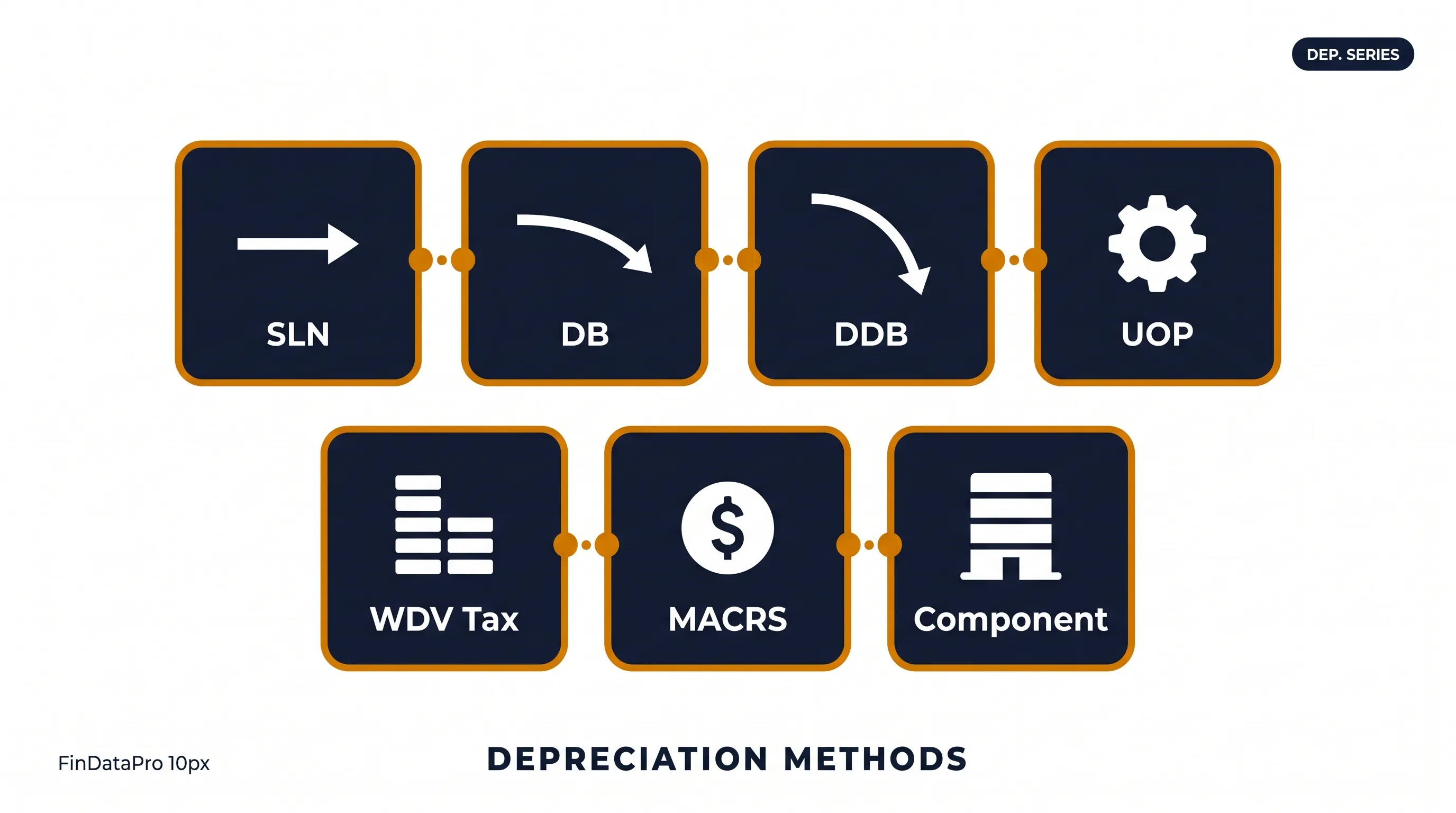
Straight-line, DDB, WDV, MACRS, Units of Production and Component (IAS 16): all 7 depreciation methods with formulas, Excel schedules, and IAS 16 rules.

ACA | FMVA® | 19 Years in Finance
The depreciation method in your fixed asset register was probably chosen by the accountant who set it up. Nobody has reviewed it since. Your auditors circled it last quarter, asked whether the method reflects the actual consumption pattern of the asset, and the answer your team gave was: "That's how we've always done it."
That is not a defensible position under IAS 16. In a GCC audit environment where Big Four teams and regulators are focused increasingly on fixed asset disclosures: particularly useful life estimates and method appropriateness: it is the kind of answer that extends audit timelines and surfaces prior-year adjustment risks.
The choice of depreciation methods is not a formatting decision. It determines your P&L profile across every year of an asset's life, your deferred tax balance, your net asset values, and your compliance position under every regime you operate in. For most GCC entities, that means IFRS for the financials and a local tax code for the tax return. Two different calculations. Two different numbers. A deferred tax entry that needs to be explained clearly in the notes.
This guide covers all 7 depreciation methods: what they are, how they work mechanically, when each one is appropriate, what each does to your P&L and balance sheet, and where the compliance obligations sit. Each method section links to a full deep-dive post with worked schedules, Excel implementation, and FAQ. Start here for the framework. Follow the links for the depth.
Table of Contents {#toc}
- What Is Depreciation and Why the Method Matters
- All 7 Depreciation Methods at a Glance
- Method 1: Straight-Line Depreciation (SLN)
- Method 2: Declining Balance: Companies Act India (WDV)
- Method 3: Double Declining Balance (DDB)
- Method 4: Units of Production (UOP)
- Method 5: WDV: Indian Income Tax Act
- Method 6: MACRS: US Tax Depreciation
- Method 7: Component Method (IAS 16)
- How to Choose the Right Method
- Frequently Asked Questions
- Conclusion
What Is Depreciation and Why the Method Matters {#what-is-depreciation}
IAS 16 defines depreciation as the systematic allocation of the depreciable amount of an asset over its useful life. The depreciable amount is cost less residual value. The systematic allocation is where the method choice comes in: it determines how that depreciable amount is spread across accounting periods.
The standard requires the method to reflect the pattern in which the asset's future economic benefits are consumed. That sentence in IAS 16.60 is doing a lot of work. It means the method is not arbitrary and it cannot be selected purely for convenience. It must follow the economics of how the asset wears out, loses productive capacity, or becomes obsolete.
In practice, many entities pick straight-line and do not revisit the decision. That is the right answer for some assets. For assets that degrade rapidly in early life, or whose wear-out pattern tracks production volume rather than the passage of time, straight-line produces a book value that does not reflect economic reality: and a deferred tax position that requires explanation.
The full IAS 16 standard is published by the IFRS Foundation at ifrs.org.
All 7 Depreciation Methods at a Glance {#comparison-table}
| Method | Formula Basis | IFRS Permitted | Indian Companies Act | US Tax (MACRS) | Excel Function |
|---|---|---|---|---|---|
| Straight-Line (SLN) | (Cost - Salvage) / Life | Yes | Yes (Schedule II) | Alternative only | =SLN() |
| Declining Balance / WDV | Book Value × Fixed Rate | Yes | Yes (Schedule II WDV) | No | =DB() |
| Double Declining Balance (DDB) | Book Value × (2 / Life) | Yes | No standard | No | =DDB() |
| Units of Production (UOP) | (Cost - Salvage) × (Units / Total Units) | Yes | No standard | No | Manual formula |
| WDV: Income Tax Act India | Block of Assets × Prescribed Rate | No (tax only) | No (tax only) | No | Manual |
| MACRS | IRS prescribed % by property class | No (US tax only) | No | Yes | Manual / VLOOKUP |
| Component Method | Each component depreciated separately per IAS 16 | Yes (required for significant components) | No standard | No | Manual per component |
Method 1: Straight-Line Depreciation (SLN) {#straight-line}
Most accountants reach for straight-line without asking whether it fits. For some assets, it is the correct answer. For others, it silently distorts the P&L by allocating the same charge in Year 1 as in Year 5: even when the asset's productive capacity has dropped significantly by Year 3.
The right question is not "which method is simplest?" It is "how does this asset actually lose its value?" If the answer is evenly over time, straight-line is correct. If the answer is front-loaded, or tied to production volume, it is not.
The formula:
Annual Depreciation = (Cost - Salvage Value) / Useful Life
How it works:
A company vehicle in Bahrain. Cost: USD 35,000. Salvage value: USD 5,000. Useful life: 5 years.
Annual depreciation: (35,000 - 5,000) / 5 = USD 6,000 per year.
| Year | Opening Book Value (USD) | Depreciation (USD) | Accumulated Depreciation (USD) | Closing Book Value (USD) |
|---|---|---|---|---|
| 1 | 35,000 | 6,000 | 6,000 | 29,000 |
| 2 | 29,000 | 6,000 | 12,000 | 23,000 |
| 3 | 23,000 | 6,000 | 18,000 | 17,000 |
| 4 | 17,000 | 6,000 | 24,000 | 11,000 |
| 5 | 11,000 | 6,000 | 30,000 | 5,000 |
Equal charges. Predictable P&L. Simple audit trail.
Where it fits and where it does not:
Straight-line is appropriate for assets where economic benefit flows evenly: office furniture, leasehold improvements, long-life manufacturing equipment with consistent output. It is less appropriate for vehicles (which depreciate sharply in early years), technology assets (where obsolescence accelerates value loss), and production equipment where usage varies significantly year to year.
The IAS 16 review requirement that most finance teams miss:
IAS 16.61 requires the residual value, useful life, and depreciation method to be reviewed at each financial year-end. Not once at the time of capitalisation. Not at management's discretion. At every year-end. In most GCC entities, the original useful life estimate from the capitalisation date is still in the register unchanged. That is an audit observation waiting to happen.
Deferred tax:
If your tax jurisdiction uses a different method or rate, every year produces a timing difference between tax depreciation and book depreciation. Under IAS 12, that difference must be recognised as a deferred tax asset or liability. The cumulative deferred tax balance grows until the asset is fully depreciated or disposed of. This is not optional accounting.
Excel: =SLN(cost, salvage, life) returns the annual charge. To build a full schedule, use the function in a table with year as the row counter.
Full guide: Straight-Line Depreciation: Formula, Example and Excel
Method 2: Declining Balance: Companies Act India (WDV) {#declining-balance-companies-act}
Under the Companies Act 2013, Indian companies depreciate assets based on prescribed useful lives from Schedule II: not prescribed rates. The rate is derived from the useful life. That distinction matters and it is the one most practitioners get backwards.
The confusion arises because accountants default to looking for a rate table. Schedule II does not give you a rate. It gives you the useful life. You compute the rate from it using the residual value assumption.
The formula:
WDV Rate = 1 - (Residual Value / Cost)^(1 / Useful Life)
Schedule II mandates a default residual value of 5% of cost unless a company can demonstrate and justify an alternative. The rate is then applied to the opening written-down book value each year, not to the original cost. This is what makes it a declining balance method: the same rate applied to a shrinking base produces declining charges over time.
Example:
Office furniture, Indian company. Cost: INR 500,000. Residual value: INR 25,000 (5%). Useful life per Schedule II: 10 years.
WDV Rate = 1 - (25,000 / 500,000)^(1/10) = 25.89% (approx)
| Year | Opening Book Value (INR) | Depreciation at 25.89% (INR) | Closing Book Value (INR) |
|---|---|---|---|
| 1 | 500,000 | 129,450 | 370,550 |
| 2 | 370,550 | 95,939 | 274,611 |
| 3 | 274,611 | 71,126 | 203,485 |
| 4 | 203,485 | 52,682 | 150,803 |
| 5 | 150,803 | 39,043 | 111,760 |
The charge in Year 1 is nearly three times the charge in Year 5. The P&L front-loads the depreciation into the early life of the asset. This is intentional: declining balance reflects the reality that most assets lose a larger proportion of their economic value in early years.
Companies Act vs Income Tax Act: not the same thing
This is the most common misconception among Indian finance practitioners. Companies Act WDV:
- Derives the rate from useful life (Schedule II)
- Applies to individual assets
- Uses a 5% residual value by default
Income Tax Act WDV:
- Uses prescribed rates directly (Section 32)
- Applies to a block of assets (not individual assets)
- Has no residual value concept
The two calculations will almost always produce different numbers. The difference is deferred tax. Full comparison in the WDV Income Tax guide.
Component accounting:
Both IAS 16 and the Companies Act require significant components of an asset to be identified and depreciated separately when they have different useful lives. A manufacturing plant with an engine that requires replacement every 5 years, a building with a roof on a 15-year cycle, a production line with a hydraulic system on a 7-year maintenance schedule: each component must carry its own depreciation track. Component identification at the time of capitalisation is not optional: it is a direct requirement.
Excel: =DB(cost, salvage, life, period, [month]) implements fixed-rate declining balance. Excel rounds the internal rate to three decimal places, so results may differ slightly from manual calculation. For audit-grade schedules, calculate the rate manually and document it.
Full guide: WDV Depreciation: Companies Act 2013, Schedule II
Method 3: Double Declining Balance (DDB) {#double-declining-balance}
Double Declining Balance runs at twice the straight-line rate. That rate is applied to the opening book value each period, not to the original cost. It produces the steepest depreciation front-loading of any standard accounting method: and it requires a switch to straight-line at a specific point that most textbooks do not cover clearly.
The formula:
DDB Rate = 2 / Useful Life Period Depreciation = Opening Book Value × DDB Rate
For a 5-year asset, the DDB rate is 2/5 = 40%. That 40% applied to a declining book value produces charges that shrink year on year.
The switch-to-straight-line rule:
In the later periods of an asset's life, the DDB charge will fall below what straight-line depreciation would produce for the remaining years. At that crossover point, you switch to straight-line. This is necessary to bring the book value down to the salvage value by the end of the asset's useful life. Ignore the switch and you leave a residual balance above salvage at the end of Year 5: which is a compliance error.
Example:
IT equipment. Cost: USD 20,000. Salvage value: USD 2,000. Life: 5 years. DDB rate: 40%.
| Year | Opening BV (USD) | DDB Charge (USD) | SLN Remaining (USD) | Charge Applied (USD) | Closing BV (USD) |
|---|---|---|---|---|---|
| 1 | 20,000 | 8,000 | : | 8,000 | 12,000 |
| 2 | 12,000 | 4,800 | : | 4,800 | 7,200 |
| 3 | 7,200 | 2,880 | : | 2,880 | 4,320 |
| 4 | 4,320 | 1,728 | 1,160 | 1,728 | 2,592 |
| 5 | 2,592 | 1,037 | 592 | 592 | 2,000 |
In Year 5, the DDB charge of USD 1,037 exceeds what is needed to bring the book value to USD 2,000 salvage. The correct charge is USD 592 (straight-line for remaining period). Excel's =DDB() handles this switch automatically; manual schedules must include the logic explicitly.
Where DDB fits:
Technology assets: computers, servers, software infrastructure: lose productive value and market relevance rapidly in the first two to three years. DDB reflects that economic reality more accurately than straight-line. The front-loaded charge is higher in early periods when the asset is delivering peak value, and lower in later periods when it is approaching replacement. That is the correct matching of expense to economic consumption.
IFRS position:
IFRS permits DDB. IAS 16 requires consistent application and an annual review of whether the method still reflects the consumption pattern. US GAAP also permits it. The Indian Companies Act does not prescribe DDB, but it is not prohibited for entities that are not subject to Schedule II requirements.
Excel: =DDB(cost, salvage, life, period, [factor]): the factor defaults to 2 (double declining). Setting it to 1.5 produces a 150% declining balance method, used in some US tax contexts under the pre-MACRS regime.
Full guide: Double Declining Balance: Formula, Example and Excel DDB
Method 4: Units of Production (UOP) {#units-of-production}
Units of Production is the only depreciation method that links the charge directly to what the asset actually did in the period. Time is irrelevant. The depreciation charge is zero in a period where the asset sits idle. It is highest in periods of peak output. This makes it the most accurate method for assets where physical wear tracks production volume rather than the passage of time.
The formula:
Period Depreciation = (Cost - Salvage Value) × (Units Produced in Period / Total Expected Units over Useful Life)
Where it belongs:
Manufacturing equipment with a rated cycle count. Vehicles with defined mileage limits. Aircraft depreciated per flight cycle. Oil and gas production assets measured in barrels. Any asset where you can measure the denominator reliably: total expected units, hours, kilometres, or cycles over the asset's useful life: and where physical wear correlates directly with that usage measure.
It is not appropriate when usage cannot be measured reliably, when the asset's useful life is driven by obsolescence rather than physical wear, or when production volumes are too volatile to produce a defensible estimate of total expected output.
GCC context:
Manufacturing facilities across the UAE and Saudi Arabia commonly apply UOP to heavy production equipment precisely because the correlation between production cycles and asset wear is direct and measurable. Component accounting is required under IAS 16 for giga-project infrastructure assets, where different structural elements have materially different consumption patterns and replacement schedules.
Example:
Manufacturing machine, UAE facility. Cost: USD 150,000. Salvage value: USD 15,000. Total expected output: 500,000 units over useful life.
Depreciable amount per unit: (150,000 - 15,000) / 500,000 = USD 0.27 per unit
| Year | Units Produced | Depreciation (USD) | Closing Book Value (USD) |
|---|---|---|---|
| 1 | 80,000 | 21,600 | 128,400 |
| 2 | 40,000 | 10,800 | 117,600 |
| 3 | 95,000 | 25,650 | 91,950 |
| 4 | 120,000 | 32,400 | 59,550 |
| 5 | 165,000 | 44,550 | 15,000 |
The P&L follows the business cycle. In a low-production year, the depreciation charge falls. In a high-output year, it rises. This matching is what IAS 16.60 requires when the asset's economics are production-driven.
Component accounting under IAS 16:
When a significant part of an asset has a different useful life or a different consumption pattern from the whole asset, IAS 16 requires it to be recognised as a separate component and depreciated separately. This is not optional for material components. The compressor on a petrochemical unit, the roof on a commercial property, the gearbox on a heavy vehicle: each carries its own depreciation track with its own method and useful life estimate.
Excel: There is no built-in Excel function for UOP. Build the formula manually in a table:
= (Cost - Salvage) / Total_Expected_Units * Units_This_Period
Full guide: Units of Production Depreciation: Formula, Example and IAS 16
Method 5: WDV: Indian Income Tax Act {#wdv-income-tax}
When Indian accountants say "WDV depreciation" without specifying the statute, they usually mean the Income Tax Act version. This is also the version most frequently described incorrectly in online resources. The block of assets concept is specific, non-intuitive, and matters for both the depreciation number and the tax return.
Section 32 of the Income Tax Act 1961:
Tax depreciation in India is governed by Section 32 of the Income Tax Act 1961. The key structural difference from Companies Act WDV: depreciation is not calculated on individual assets. It is calculated on a block of assets: a group of all assets of the same class and the same prescribed rate.
How the block works:
WDV of Block = Opening WDV + Additions during the year - Sale proceeds of assets disposed of
Depreciation is then applied to the WDV of the block at the prescribed rate. Individual asset tracking is not done for tax purposes. When you sell an asset, its sale proceeds reduce the block WDV. The block continues to exist until the last asset in that class is sold.
Prescribed rates (Section 32, Income Tax Act 1961):
| Asset Class | Prescribed Rate |
|---|---|
| Buildings (residential) | 5% |
| Buildings (commercial and others) | 10% |
| Furniture and fittings | 10% |
| Plant and Machinery (general) | 15% |
| Motor vehicles (not used in business of running on hire) | 15% |
| Computers and computer software | 40% |
| Ships | 20% |
Full rates are published at incometaxindia.gov.in.
Half-year rule:
If an asset is purchased after 30 September (i.e., in the second half of the Indian financial year running April to March), only 50% of the standard depreciation rate is allowed in the year of purchase. Additions before 30 September get the full year's depreciation.
Example:
Block: Plant and Machinery (15% rate)
| Item | Amount (INR) |
|---|---|
| Opening WDV of block | 800,000 |
| Addition in April (full year eligible) | 200,000 |
| Sale proceeds of one machine disposed | (50,000) |
| WDV for depreciation | 950,000 |
| Depreciation at 15% | (142,500) |
| Closing WDV | 807,500 |
Terminal depreciation and balancing charge:
If the total sale proceeds from all assets in a block in a year exceed the WDV of the block, the excess is a balancing charge: taxable income. If the block WDV turns negative after all assets in the block are sold, you can claim terminal depreciation for the remaining negative balance. These rules matter when restructuring or disposing of large asset pools.
The deferred tax position:
Tax depreciation under the Income Tax Act will almost always differ from book depreciation under the Companies Act. Every year. The cumulative difference is a temporary timing difference under IAS 12 and must be recognised as a deferred tax liability (when tax depreciation exceeds book) or deferred tax asset (when book depreciation exceeds tax). For an entity with a large fixed asset base, this deferred tax balance can be material.
Building and maintaining parallel depreciation schedules: one for the Companies Act, one for the Income Tax Act: is the compliance requirement for every Indian entity with fixed assets. Managing that across 50+ assets manually is where errors accumulate.
DepreciationLab handles both WDV calculations automatically: Companies Act useful-life-derived rates and Income Tax Act block-of-assets logic, running in parallel for every asset in your register. Try DepreciationLab at depreciationlab.org.
Full guide: WDV Depreciation: Income Tax Act 1961, Section 32, Block of Assets
Method 6: MACRS: US Tax Depreciation {#macrs}
MACRS applies only in the United States for federal income tax purposes. It does not apply to IFRS reporting. It does not apply to US GAAP financial statements. Finance professionals outside the US encounter it when consolidating US subsidiaries, reviewing US private equity portfolio company tax returns, or working with US investors who want to understand the tax depreciation position of a US asset.
What makes MACRS structurally different:
MACRS uses prescribed percentage tables from IRS Publication 946. There is no useful life estimate. There is no formula. The IRS assigns your asset to a property class based on asset type. The table gives you the depreciation percentage for each year. You multiply that percentage by the asset's cost basis.
The percentages are not tied to the actual wear pattern of any specific asset. They are policy-driven, designed for tax administration and economic stimulus, not accounting accuracy. That is why MACRS is never permitted for IFRS or GAAP financial reporting.
Property classes:
| MACRS Class | Typical Asset Examples |
|---|---|
| 3-year | Racehorses, certain tractor units |
| 5-year | Automobiles, light trucks, computers, office equipment |
| 7-year | Office furniture, agricultural equipment, most manufacturing equipment |
| 10-year | Water transport equipment, single-purpose agricultural structures |
| 15-year | Land improvements, gas distribution facilities |
| 20-year | Farm buildings, municipal wastewater treatment plants |
| 27.5-year | Residential rental property |
| 39-year | Commercial real property |
Example: 5-year property, half-year convention
Computer equipment costing USD 10,000. GDS (General Depreciation System) rates:
| Tax Year | MACRS % | Depreciation (USD) | Remaining Basis (USD) |
|---|---|---|---|
| 1 | 20.00% | 2,000 | 8,000 |
| 2 | 32.00% | 3,200 | 4,800 |
| 3 | 19.20% | 1,920 | 2,880 |
| 4 | 11.52% | 1,152 | 1,728 |
| 5 | 11.52% | 1,152 | 576 |
| 6 | 5.76% | 576 | 0 |
Note that 5-year property spans 6 tax years. The half-year convention treats all assets placed in service during a year as if placed in service on 1 July, producing a half-year of depreciation in both Year 1 and the final year.
Bonus depreciation (Section 168(k)):
Bonus depreciation has been phasing down from the 100% rate available from 2017 to 2022. The current-year percentage changes with tax legislation. Always verify the applicable rate at IRS.gov/pub/irs-pdf/p946.pdf before filing or advising. Any source that does not cite the current tax year should not be relied upon for this figure.
Section 179:
Section 179 allows immediate expensing of qualifying property up to an annual dollar limit, subject to income limitations. It operates separately from MACRS and can be used in combination with it. For assets not fully covered by Section 179, the remaining basis goes into MACRS.
ADS vs GDS:
MACRS offers two systems: the General Depreciation System (GDS, the default, using accelerated rates) and the Alternative Depreciation System (ADS, which uses straight-line over longer lives). ADS is required for certain listed property, assets used predominantly outside the US, and assets used in tax-exempt activities.
Excel: There is no built-in Excel function for MACRS. Build a VLOOKUP table against the IRS percentage tables for the relevant property class. Reference the official IRS Publication 946 tables for accurate percentages.
Full guide: MACRS Depreciation: IRS Rules, Property Classes and Calculation
Method 7: Component Method (IAS 16) {#component-method}
Most GCC entities know component accounting is an IFRS requirement. Most have not applied it properly. It is one of the most consistently flagged IAS 16 non-compliance areas in listed entity audits across Bahrain and Saudi Arabia: not because the concept is unclear, but because the initial componentisation work was never done at the time of capitalisation.
The requirement:
IAS 16.43–47: when a significant part of an item of property, plant and equipment has a useful life that differs from the rest of the item, it must be depreciated separately. "Significant" is a judgement call: IAS 16 sets no quantitative threshold. In practice, most entities apply componentisation when a part exceeds approximately 10 to 15% of the total asset cost. That policy must be documented and applied consistently.
Why it matters to the P&L:
A commercial building in Bahrain acquired for USD 5,000,000. Treated as a single asset over 40 years: USD 125,000 per year. Componentised correctly:
| Component | Cost (USD) | Useful Life | Annual Depreciation (USD) |
|---|---|---|---|
| Structure | 2,500,000 | 40 years | 62,500 |
| Roof | 750,000 | 20 years | 37,500 |
| HVAC System | 500,000 | 15 years | 33,333 |
| Lifts / Elevators | 400,000 | 20 years | 20,000 |
| Interior Fit-Out | 850,000 | 10 years | 85,000 |
| Total | 5,000,000 | : | 238,333 |
Single asset approach: USD 125,000 per year. Component method: USD 238,333 per year. Nearly double. That is not a rounding difference. It is a material understatement of depreciation: and a material overstatement of the closing book value: in every year the building is held under the single-asset approach.
What happens when a component is replaced:
When a component reaches the end of its useful life and is replaced, the old component's carrying amount is derecognised from the balance sheet and the new component is capitalised at its cost. Treating a roof replacement or HVAC overhaul as a maintenance expense: when it meets the recognition criteria for capitalisation as a new component: is an error in both the P&L and the asset register.
Full guide: Component Depreciation: IAS 16 Guide with Worked Examples
How to Choose the Right Depreciation Method {#decision-framework}
The method must match the consumption pattern of the asset. That is the IAS 16 requirement. It is also the practical test. The table below translates that requirement into a decision framework for the four most common scenarios.
| Situation | Method | Why |
|---|---|---|
| Asset wears out evenly over time, benefits flow uniformly | Straight-Line (SLN) | Equal charges match economic reality; simple audit trail |
| Indian entity: asset governed by Companies Act 2013 | WDV per Schedule II | Legal requirement; rate derived from prescribed useful life |
| US tax asset | MACRS (GDS) | Legal requirement; use IRS prescribed tables for the property class |
| Asset loses value sharply in early years (vehicles, tech) | DDB or WDV/DB | Front-loaded charge matches rapid early economic consumption |
| Asset wear-out tracks production volume, not time | Units of Production | P&L charge follows actual business activity |
| Indian entity: computing deferred tax | Both WDV (Income Tax) AND book method | Two parallel calculations required under IAS 12 |
| Asset with significant components of different lives | Component accounting + separate method per component | IAS 16 requirement; also Companies Act requirement for Indian entities |
The annual review obligation:
The method is not a one-time decision. IAS 16.61 requires the residual value, useful life, and depreciation method to be reviewed at every financial year-end. That review must be documented. In the absence of documentation, auditors treat the original estimate as unreviewed and potentially unsupported: regardless of whether the estimate turns out to be accurate.
The deferred tax calculation that follows every method decision:
Every jurisdiction-specific depreciation method creates a timing difference against the accounting method. India: Income Tax Act WDV vs Companies Act WDV. US: MACRS vs GAAP straight-line or DDB. That timing difference is not a disclosure footnote. It is a balance sheet item under IAS 12. Finance teams that track only one depreciation schedule are producing an incomplete balance sheet.
Frequently Asked Questions {#faq}
What are the main depreciation methods in accounting?
The main depreciation methods covered under IFRS and major tax regimes are: Straight-Line (SLN), Declining Balance / WDV under Companies Act India, Double Declining Balance (DDB), Units of Production (UOP), Written Down Value under the Indian Income Tax Act (Section 32), MACRS for US federal tax, and the Excel DB function for implementing declining balance in spreadsheet models.
Which depreciation method is required under IFRS and IAS 16?
IAS 16 does not mandate a single method. It requires the method to reflect the pattern in which the asset's future economic benefits are consumed. Straight-line, diminishing balance, and units of production are all permitted under IFRS. The method must be applied consistently and reviewed at each financial year-end. The full standard is at ifrs.org.
What is the difference between accounting depreciation and tax depreciation?
Accounting depreciation follows IFRS or local GAAP and reflects economic consumption of the asset over its useful life. Tax depreciation follows jurisdiction-specific rules designed for revenue collection, not economic representation. In India: Companies Act for accounting, Income Tax Act for tax. In the US: GAAP for accounting, MACRS for tax. The difference between the two creates deferred tax assets or liabilities under IAS 12.
Which depreciation method gives the highest charge in year one?
Double Declining Balance produces the highest accounting depreciation in Year 1 among standard IFRS methods. In the US tax context, MACRS with bonus depreciation under Section 168(k) can exceed even DDB in Year 1 for qualifying property. The choice depends on whether you are managing accounting P&L presentation or tax cash flow optimisation.
Can a company change its depreciation method after initial recognition?
Yes. Under IAS 8, it is treated as a change in accounting estimate: not a change in accounting policy. The change must be justified by evidence that the new method better reflects the consumption pattern. It is applied prospectively: no restatement of prior-period comparatives. The financial effect of the change must be disclosed in the notes.
How do I build a depreciation schedule in Excel for all methods?
Excel has four built-in functions: =SLN() for straight-line, =DB() for fixed-rate declining balance, =DDB() for double declining balance, and =VDB() for variable declining balance with an optional DDB-to-SLN switch. Units of Production and Income Tax Act WDV require manual formulas. Build a table with the year as the row driver and call the appropriate function against each period. For DDB, include logic to cap the charge at the straight-line equivalent in the periods where DDB overshoots.
What is the difference between WDV under Companies Act and WDV under Income Tax Act in India?
Structurally different calculations. Companies Act 2013: the rate is derived from useful lives in Schedule II, applied to individual assets, with a default residual value of 5% of cost. The MCA Schedule II is at mca.gov.in. Income Tax Act 1961: fixed prescribed rates applied to a block of assets grouped by class, no residual value concept. The Section 32 rates are at incometaxindia.gov.in. These two calculations produce different depreciation numbers for the same asset every year without exception.
What is MACRS depreciation and when does it apply?
MACRS (Modified Accelerated Cost Recovery System) is the US federal tax depreciation system for assets placed in service after 1986. It assigns assets to property classes (3-year through 39-year) and uses prescribed percentage tables from IRS Publication 946. The half-year convention applies to most personal property. MACRS is not permitted for IFRS or US GAAP financial reporting: it applies to the US tax return only.
Conclusion {#conclusion}
Seven methods. Each has a specific application, a specific jurisdiction, and a specific effect on the numbers. Using the wrong method does not just produce the wrong depreciation charge: it produces the wrong deferred tax balance, the wrong net asset value, and: in regulated entities: the wrong compliance position.
The annual review obligation under IAS 16.61 is not optional. The parallel tax calculation under IAS 12 is not optional. Building and maintaining schedules for both, across a full asset register, manually, in Excel, is where version errors and formula drift accumulate.
Stop rebuilding depreciation schedules from scratch each year. DepreciationLab handles all 7 depreciation methods: straight-line, WDV (Companies Act), WDV (Income Tax block of assets), DDB, units of production, MACRS, and Excel DB: in one tool built for accountants and finance professionals.
Try DepreciationLab Free → The free plan covers 10 assets across all 7 methods. Professional is $12 per month or $99 per year: a 150-asset register, bulk Excel upload, and audit workpapers.
This is the pillar post of the FinDataPro Depreciation Methods Series. Each spoke post covers one method in full: worked schedules, Excel implementation, IFRS and tax compliance guidance, and FAQ.
Related posts in this series:
- Straight-Line Depreciation: Formula, Example and Excel
- WDV Depreciation: Companies Act 2013
- Double Declining Balance: Formula, Example and Excel DDB
- Units of Production Depreciation: Formula and IAS 16
- WDV Depreciation: Income Tax Act 1961
- MACRS Depreciation: IRS Rules and Property Classes
- Component Depreciation Method: IAS 16 Guide with Worked Examples
- Free Fixed Asset Depreciation Calculator (Excel)
⚡Try It Yourself
Compare all 7 depreciation methods side-by-side and calculate schedules instantly. Start free at Depreciation Lab →
Prashant Panchal is a Chartered Accountant (ACA) and Financial Modelling & Valuation Analyst (FMVA®) with 19 years of experience in finance, FP&A, and financial modelling across the GCC region. He is the founder of FinDataPro.
Discussion
Leave a Comment
Comments are moderated and appear once approved.