
WDV Depreciation Under Companies Act 2013: Rates, Formula and Schedule II
Complete guide to Written Down Value depreciation under Companies Act 2013 Schedule II. How to derive the rate from useful life, worked example, and Excel DB function.

ACA | FMVA® | 19 Years in Finance
Most Indian accountants know that Schedule II of the Companies Act 2013 governs depreciation. Far fewer apply it correctly. The common mistake is treating Schedule II as a rate table and looking for a percentage. It is not a rate table. It is a useful life table. The rate has to be calculated from it.
This is not a minor distinction. If you are using WDV rates from a pre-2013 source: the Companies Act 1956 explicitly prescribed rates: and applying them under the 2013 Act, you are using the wrong methodology. The 2013 Act moved from prescribed rates to prescribed useful lives. The rate is now derived, not looked up.
The WDV depreciation Companies Act 2013 framework requires three inputs: cost, residual value (5% of cost by default), and the useful life from Schedule II. The rate emerges from those three. This is the calculation most Indian depreciation schedules get wrong, and it affects every asset class.
Table of Contents {#toc}
- What the Companies Act 2013 Says About WDV Depreciation
- Schedule II: Useful Lives, Not Rates
- The WDV Formula and Rate Derivation
- Residual Value: The 5% Default
- Step-by-Step Worked Example
- Year-by-Year WDV Schedule
- Excel DB Function: Implementation and Limitations
- WDV vs Straight-Line Under Companies Act: Which to Choose
- Companies Act WDV vs Income Tax Act WDV: Not the Same
- Frequently Asked Questions
- Conclusion
What the Companies Act 2013 Says About WDV Depreciation {#what-companies-act-says}
Section 123(2) of the Companies Act 2013 requires depreciation to be provided in accordance with Schedule II. Schedule II prescribes the useful lives of various categories of assets. It does not prescribe depreciation rates.
The company then applies the depreciation method (SLN or WDV) to allocate the depreciable amount: cost less residual value: across the useful life. The method must be applied consistently across all assets of the same class, and must be disclosed in the accounting policy note.
For WDV, the useful life from Schedule II is used to derive the fixed annual rate. That rate is then applied to the declining book value. The mathematics are straightforward, but the input comes from the useful life table, not from a rate table.
The Ministry of Corporate Affairs publishes Schedule II at mca.gov.in. Any source that shows you a WDV rate table for Companies Act 2013 without referencing the underlying useful life from Schedule II should be treated with caution.
Schedule II: Useful Lives, Not Rates {#schedule-ii}
Schedule II provides the useful lives for the following broad asset categories. This is an extract of the most commonly applied categories:
| Asset Category | Useful Life |
|---|---|
| Buildings: factory and other buildings | 30 years |
| Buildings: residential buildings | 60 years |
| Plant and Machinery: general | 15 years |
| Plant and Machinery: electrical installations | 10 years |
| Furniture and Fixtures: general | 10 years |
| Motor Vehicles: buses and coaches | 6 years |
| Motor Vehicles: cars and motor cycles | 8 years |
| Motor Vehicles: commercial vehicles | 8 years |
| Office Equipment: general | 5 years |
| Computers and Data Processing Units | 3 years |
| Servers and Networks | 6 years |
Important: Schedule II also provides for certain assets where the useful life is described as the "life of the project" or "lease period." For those assets, the depreciation is spread over the project life or lease term, not a fixed period.
For assets in categories not covered by Schedule II, the company must estimate a useful life that reflects the asset's economic consumption pattern: consistent with IAS 16 / Ind AS 16. That estimate must be documented and disclosed.
The WDV Formula and Rate Derivation {#formula}
Once the useful life is established from Schedule II, the WDV rate is derived using the following formula:
WDV Rate = 1 - (Residual Value / Cost)^(1 / Useful Life)
This formula produces the fixed annual percentage that, when applied to the declining book value each year, will bring the book value to exactly the residual value by the end of the useful life.
Why this formula works:
The formula is the mathematical inverse of compound interest. If a value declines at a fixed annual rate r for n years from an initial amount to a final amount, then r = 1 - (final/initial)^(1/n). Applied to depreciation: the initial amount is cost, the final amount is residual value, and n is useful life.
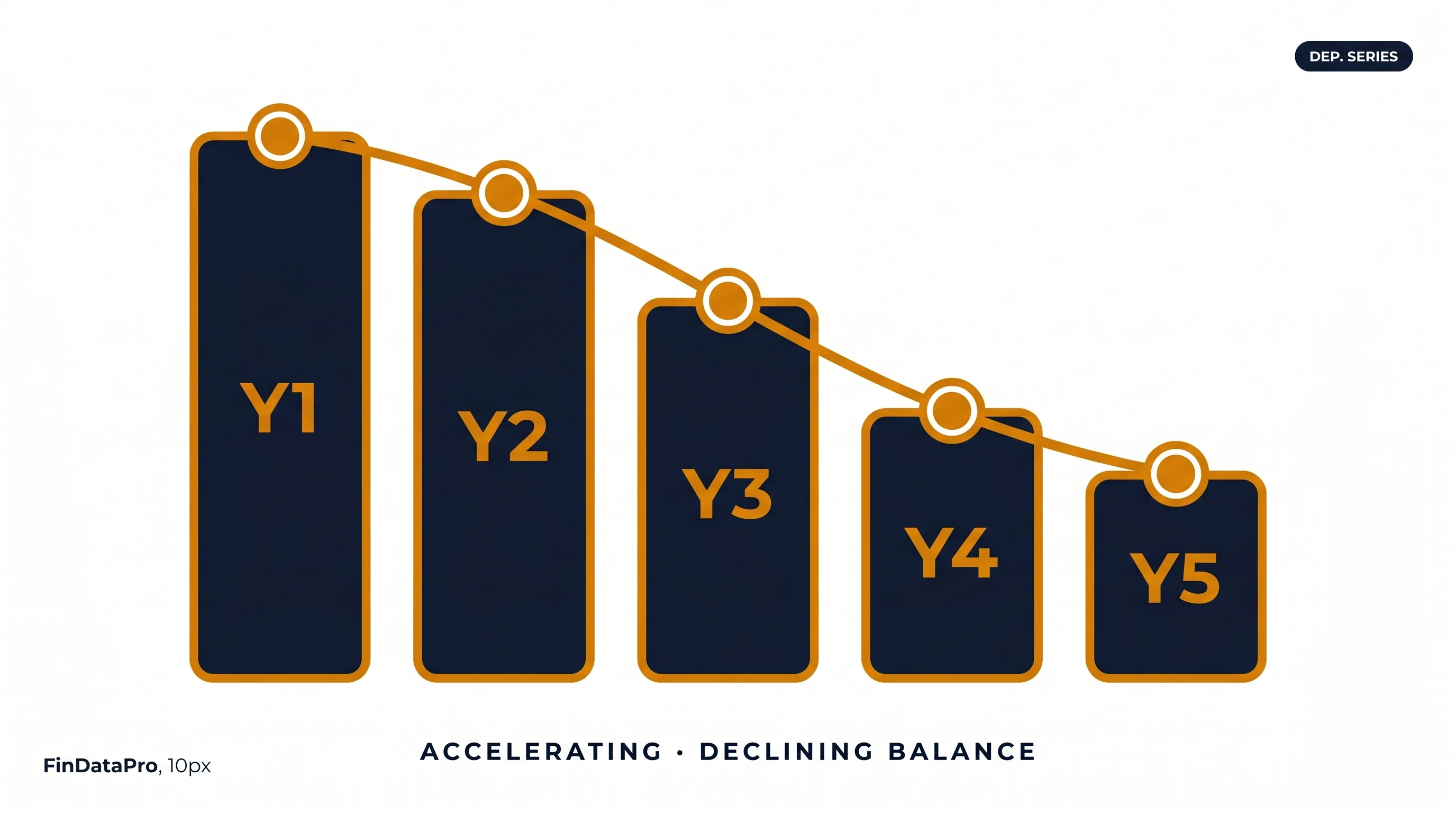
The rate is fixed. The book value it applies to declines each year. So the depreciation charge itself declines each year: high in Year 1, low in Year N. That is what distinguishes WDV from straight-line.
Residual Value: The 5% Default {#residual-value}
Schedule II mandates a default residual value of 5% of the original cost. This is not optional: it is the default that applies unless the company can demonstrate and justify a different figure.
A company may deviate from the 5% default if it has evidence that a different residual value is more appropriate for a specific asset class. That evidence must be documented. The departure must be disclosed in the financial statements.
The practical effect:
For a straight-line calculation, the residual value reduces the depreciable amount. For a WDV calculation, it does something different: it determines the mathematical rate. Changing the residual value assumption changes the rate. A lower residual value (e.g., 1%) produces a higher rate and steeper depreciation. A higher residual value (e.g., 10%) produces a lower rate and gentler depreciation.
| Residual Value Assumption | Derived WDV Rate (10-year life, INR 500,000 cost) |
|---|---|
| 1% = INR 5,000 | 32.97% |
| 5% = INR 25,000 | 25.89% |
| 10% = INR 50,000 | 20.57% |
This is why the residual value assumption is not a footnote. It changes the rate: and therefore the entire depreciation schedule: for every year of the asset's life.
Step-by-Step Worked Example {#worked-example}
Asset: Office furniture, Indian company
| Input | Value |
|---|---|
| Cost | INR 500,000 |
| Residual value (5% default) | INR 25,000 |
| Useful life (Schedule II, Furniture: general) | 10 years |
| WDV Rate derived | 1 - (25,000/500,000)^(1/10) = 25.89% |
Annual depreciation calculation:
Year 1: 500,000 × 25.89% = INR 129,450 Year 2: (500,000 - 129,450) × 25.89% = 370,550 × 25.89% = INR 95,939
Each year, the same rate (25.89%) is applied to a smaller base. The charge declines. The book value declines. By Year 10, the book value reaches INR 25,000 (the 5% residual), where it stops.
Year-by-Year WDV Schedule {#schedule}
| Year | Opening Book Value (INR) | Depreciation at 25.89% (INR) | Closing Book Value (INR) |
|---|---|---|---|
| 1 | 500,000 | 129,450 | 370,550 |
| 2 | 370,550 | 95,939 | 274,611 |
| 3 | 274,611 | 71,126 | 203,485 |
| 4 | 203,485 | 52,683 | 150,802 |
| 5 | 150,802 | 39,043 | 111,759 |
| 6 | 111,759 | 28,944 | 82,815 |
| 7 | 82,815 | 21,441 | 61,374 |
| 8 | 61,374 | 15,892 | 45,482 |
| 9 | 45,482 | 11,776 | 33,706 |
| 10 | 33,706 | 8,726* | 25,000 |
*Year 10 depreciation is adjusted to bring the book value to exactly INR 25,000 (5% of cost).
Year 1 depreciation is INR 129,450. Year 10 is INR 8,726. The ratio is approximately 15:1. That is not a P&L anomaly: it is the mathematical consequence of the WDV method matching the steeper early-year consumption of the asset.
Excel DB Function: Implementation and Limitations {#excel-db}
Excel's =DB() function implements the same fixed-rate declining balance mathematics as the Companies Act WDV method. Understanding both the capability and the limitation of the function prevents the most common schedule errors.
Syntax:
=DB(cost, salvage, life, period, [month])
| Argument | Description |
|---|---|
| cost | Asset acquisition cost |
| salvage | Residual / salvage value |
| life | Useful life (matching Schedule II) |
| period | The year to calculate (1 for Year 1, 2 for Year 2, etc.) |
| [month] | Months in the first year: default 12, use the actual months if partial year |
Applied to the worked example:
=DB(500000, 25000, 10, 1) → 129,449 (differs from manual 129,450 by INR 1 due to rounding)
=DB(500000, 25000, 10, 2) → 95,939
The rounding limitation:
Excel internally calculates the rate as: rate = 1 - (salvage / cost)^(1 / life) and then rounds it to three decimal places (i.e., 25.89% rather than 25.8925...%). This produces small differences from a manual calculation using the full-precision rate. Over 10 years, these rounding differences can accumulate.
For audit-grade schedules:
Calculate the rate manually to full precision: = 1 - (B3/B2)^(1/B4) (where B2=cost, B3=residual, B4=life). Apply that full-precision rate to the declining book value in each row. Use =DB() as a cross-reference or reasonableness check: not as the primary schedule driver.
The [month] argument for partial-year assets:
If an asset is acquired part-way through the accounting year, set [month] to the number of months of the first accounting period the asset was in use. For an asset acquired on 1 October in a calendar-year entity: [month] = 3. This produces a proportionate first-period charge and extends the schedule by one period.
=DB(500000, 25000, 10, 1, 3) → proportionate charge for 3 months in Year 1.
Excel function comparison for declining balance methods:
| Function | Method | Key Difference |
|---|---|---|
| =DB() | Fixed-rate declining balance (WDV) | Rate derived from cost, salvage, life |
| =DDB() | Double declining balance | Rate = 2 × (1/life), factor adjustable |
| =VDB() | Variable declining balance with switching | Includes DDB-to-SLN switch logic |
For Companies Act WDV, =DB() is the closest built-in match. For the Income Tax Act block-of-assets calculation, no built-in function applies: that requires a manual formula.
WDV vs Straight-Line Under Companies Act: Which to Choose {#vs-sln}
Both are permitted under the Companies Act 2013. The standard does not mandate WDV. The choice must reflect the asset's actual consumption pattern.
WDV is more appropriate when:
The asset delivers the most economic value in its early years and becomes less productive or valuable over time. Motor vehicles: a car worth INR 1,200,000 new is worth INR 650,000 after one year and INR 380,000 after two. Applying straight-line produces a book value of INR 1,050,000 after Year 1: an overstatement relative to economic reality. Electronic equipment, specialised plant with high early-year output and declining performance: the same logic applies.
Straight-line is more appropriate when:
The asset delivers benefits evenly across its life. Office furniture with stable utility over 10 years. Leasehold improvements with equal utility across the lease term. Long-life manufacturing equipment with consistent output. For these, straight-line matches the consumption pattern and produces less timing distortion in the P&L.
The choice must be consistent within an asset class. You cannot apply WDV to some cars and straight-line to others. Within a class, the method is fixed. Changing the method is a change in accounting estimate under Ind AS 8: applied prospectively, with disclosure.
Companies Act WDV vs Income Tax Act WDV: Not the Same {#vs-income-tax}
This comparison comes up repeatedly in Indian practice and is frequently confused. The two methods share the name "WDV" and both apply a declining balance approach: but structurally, they are different calculations.
| Feature | Companies Act 2013 WDV | Income Tax Act 1961 WDV |
|---|---|---|
| Rates source | Derived from useful life (Schedule II) | Prescribed directly (Appendix I, Income Tax Rules) |
| Unit of calculation | Individual asset | Block of assets (pooled) |
| Residual value | 5% of cost (mandatory default) | Not applicable |
| Partial year | Proportionate to months of use | 50% restriction if after 30 September |
| Disposal treatment | Asset derecognised individually | Proceeds reduce block WDV |
| Purpose | Financial statements (Companies Act compliance) | Tax return (Income Tax Act) |
The Companies Act number is the book depreciation. The Income Tax Act number is the tax depreciation. They will almost always differ. That difference is a timing difference under Ind AS 12: a deferred tax position that must be recognised and tracked every year.
Frequently Asked Questions {#faq}
What is WDV depreciation under the Companies Act 2013?
WDV (Written Down Value) depreciation under the Companies Act 2013 is calculated by deriving a fixed annual rate from the prescribed useful life in Schedule II and the default 5% residual value, then applying that rate to the declining book value of each individual asset. The charge is higher in early years and declines over the asset's useful life.
How is the WDV rate calculated from useful life under Schedule II?
Formula: Rate = 1 - (Residual Value / Cost)^(1 / Useful Life). Example: cost INR 500,000, residual value INR 25,000 (5%), useful life 10 years. Rate = 1 - (25,000 / 500,000)^(1/10) = 25.89%. This rate is then applied to the opening book value each year.
What is the default residual value under Schedule II?
The default is 5% of the original cost. A company may use a different figure if it has evidence to support the departure. Any departure from the 5% default must be disclosed in the notes to the financial statements.
Can a company use straight-line instead of WDV under the Companies Act?
Yes. Both methods are permitted. The choice must be made consistently within an asset class and must reflect the actual consumption pattern of the asset. Changing the method is a change in accounting estimate under Ind AS 8: applied prospectively with disclosure of the financial effect.
What is the difference between WDV under Companies Act and Income Tax Act?
Companies Act: individual assets, rate derived from Schedule II useful life, 5% residual value, for financial statements. Income Tax Act: block of assets (pooled group), prescribed rates from Appendix I, no residual value, for the tax return. They will always produce different numbers for the same assets.
Does the Excel DB function calculate WDV correctly?
It uses the same mathematics but rounds the derived rate to three decimal places, producing small differences from a manually calculated schedule. For audit-grade work, calculate the rate manually to full precision and use =DB() as a cross-check rather than the primary calculation source.
When is WDV depreciation more appropriate than straight-line?
For assets that lose economic value more rapidly in early years: vehicles, computers, certain plant and machinery. The WDV front-loading of charges better matches the asset's consumption pattern in those cases. For assets with stable, even benefit delivery, straight-line remains more appropriate.
Conclusion {#conclusion}
The shift from the Companies Act 1956 to the 2013 Act changed how WDV depreciation rates are derived. Pre-2013, the Act prescribed rates. Post-2013, it prescribes useful lives and requires the rate to be computed. Many depreciation schedules in use today still carry rates derived from the old Act: which means they are producing the wrong depreciation charge every year, against every asset in the register.
The calculation itself is not complex once the mechanism is understood: derive the rate from the useful life, apply it to the declining book value, stop at 5% residual. The complexity arises when you are maintaining this for 50, 100, or 500 assets across multiple asset classes: particularly when assets are added and disposed of during the year.
Building and maintaining the full WDV schedule manually for each asset, alongside the Income Tax Act block calculations and the resulting deferred tax position, is where errors accumulate.
DepreciationLab automates Companies Act WDV calculations: schedule-II useful life rate derivation, partial-year apportionment, and the deferred tax parallel tracking: for every asset in your register.
Try DepreciationLab Free → The free plan covers 10 assets across all 7 methods. Professional is $12 per month or $99 per year: a 150-asset register, bulk Excel upload, and audit workpapers.
Part of the FinDataPro Depreciation Methods Series. Related posts:
- The Complete Guide to All 7 Depreciation Methods (Pillar)
- WDV Depreciation: Income Tax Act 1961: Block of Assets and Section 32
- Double Declining Balance: Formula, Example and Excel DDB
- Free Fixed Asset Depreciation Calculator (Excel)
⚡Try It Yourself
Calculate WDV depreciation under Companies Act 2013 with our free calculator. Start free at Depreciation Lab →
Prashant Panchal is a Chartered Accountant (ACA) and Financial Modelling & Valuation Analyst (FMVA®) with 19 years of experience in finance, FP&A, and financial modelling across the GCC region. He is the founder of FinDataPro.
Discussion
Leave a Comment
Comments are moderated and appear once approved.