
Finance Fraud Prevention Checklist: The 2026 CFO Playbook

A Hong Kong-based finance worker sat down for a video call with his CFO and three senior colleagues in early 2024.
The CFO asked him to authorise fifteen urgent wire transfers. Every single person on that screen was an AI-generated deepfake. He transferred $25 million before anyone noticed.
If your team doesn't have a current, tested finance fraud prevention checklist, that story could happen to you — regardless of your company's size or existing controls.
This guide walks through the six control areas every finance team must audit in 2026.

ACA | FMVA® | 19 Years in Finance
Finance Team Fraud Readiness Checklist 2026
The six-area RAG-scored checklist — download and assess your team now.
Why Fraud Is Getting Worse — Not Better in 2026
Most finance leaders know fraud is rising. Fewer understand how dramatically the economics have shifted.
According to the FBI IC3 2025 Annual Report, total cybercrime losses hit $20.9 billion in 2025 — a 26% jump in a single year.
Business Email Compromise alone accounted for over $3 billion of that figure. The ACFE's research shows organisations lose approximately 5% of annual revenue to occupational fraud every year.
The shift isn't just in volume. It's in sophistication.
Only 7% of anti-fraud professionals believe their organisation is more than "moderately prepared" to detect AI-powered fraud. That's a staggering gap.
The organisations that close it treat fraud as what it fundamentally is: a data problem first, and a policy problem second. The ones that struggle treat it as a compliance checkbox reviewed once a year.
This finance fraud prevention checklist is designed to change that.
Section 1: Governance, Ethics and Culture
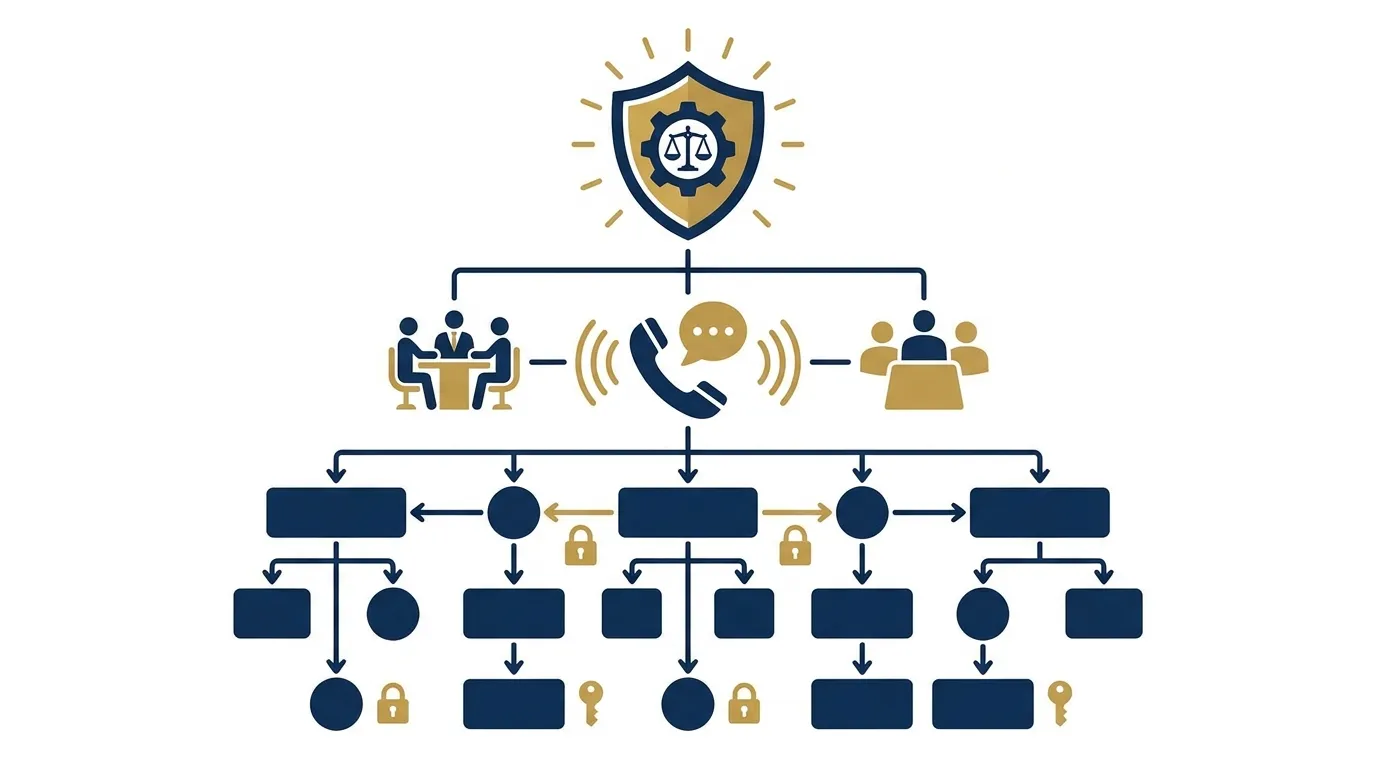
The most expensive fraud controls in the world fail when the organisation's culture doesn't support them.
Governance is not the "soft" part of fraud prevention — it's the load-bearing foundation.
The ACFE Report to the Nations 2024 makes this clear: tips from employees, customers, and vendors catch 43% of all fraud cases. Internal audit catches only 14%. Management review, 12%.
Your reporting culture is statistically your cheapest and most powerful control.
What your finance fraud prevention checklist must include for governance:
A written code of conduct communicated to all staff and third-party vendors, signed or acknowledged annually — not just posted on an intranet nobody reads
An anonymous whistleblower hotline or web portal that is genuinely accessible, publicised internally, and technically anonymous
Independent board or audit committee oversight of the fraud risk programme — separate from management review, with genuine authority to act
Mandatory fraud awareness training at every level, including senior management and the C-suite — the ACFE data shows nearly 11% of occupational fraud is committed by executives
A documented zero-tolerance policy with visible enforcement — organisations that allow fraudsters to resign quietly signal that fraud has manageable consequences
"Brushing under the carpet or allowing an internal fraudster to resign quietly with no legal recourse are poor deterrents."— Edwin Ang, Regional Finance Director, Brunel
Section 2: Data Visibility and Real-Time Monitoring
If your finance team can't query transaction data in real time and spot anomalies within minutes, you're operating blind.
This is arguably the most critical area of any fraud prevention checklist for finance teams in 2026.
Runbo Li, co-founder at Magic Power AI, discovered this when criminals exploited his billing system using stolen credit cards — triggering chargebacks that threatened his payment processor relationship entirely.
His team deployed immediate anomaly detection rules: multiple accounts from the same IP, high transaction volumes within minutes of account creation, payment data that didn't match geolocation signals.
Within a week, those rules were catching over 90% of fraudulent transactions. The lesson applies at every scale: your defences are only as good as your weakest data point.
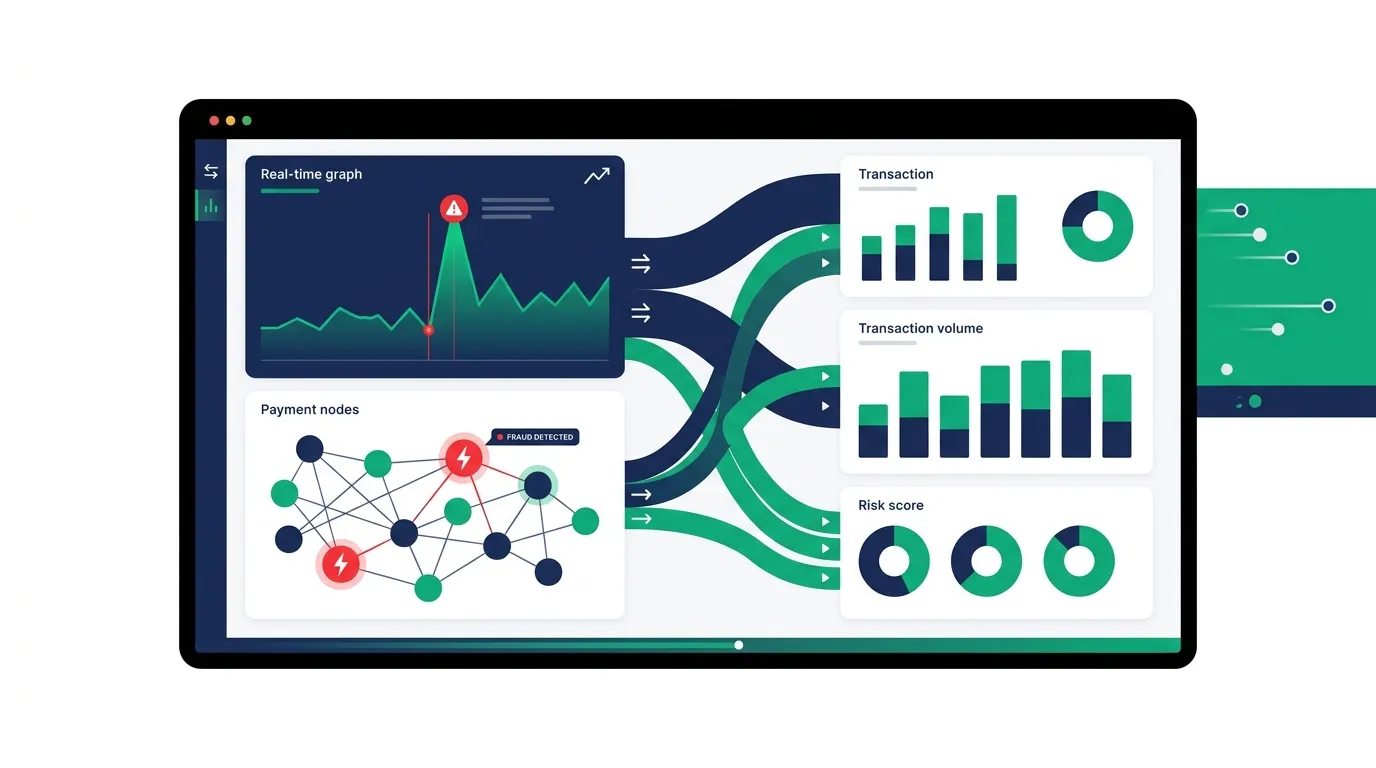
Real-time monitoring checklist items for finance teams:
Real-time transaction data access — quarterly batch reports and monthly exports create detection windows that fraudsters exploit. You need live visibility.
Automated anomaly detection covering velocity spikes, IP clustering, geolocation mismatches, and first-time payment patterns
Unified reporting across all teams — when finance, operations, and treasury work from separate data sources and parallel spreadsheets, the gaps between them become the attack surface
AI/ML risk-scoring models trained on your historical transaction data — rule-based systems alone can't handle adaptive, AI-driven fraud tactics
A single named owner for fraud risk enterprise-wide — diffuse ownership is no ownership
Data point: Organisations with real-time dashboards detect fraud approximately 40% faster than those relying on periodic reviews, according to ACFE benchmarking data. In fraud, speed is everything. Banks can reverse wire transfers — but typically only within a very short window after initiation.
For teams looking to close data gaps that fraud exploits, our guide on streamlining finance with the AI advantage walks through the data infrastructure shifts that support real-time visibility.
Section 3: Payment and Disbursement Controls
Payment workflows are the direct target of the majority of financially motivated fraud.
Every wire transfer, ACH payment, and vendor onboarding event is a potential attack vector. Your checklist must treat the entire payment lifecycle as a controlled process — not an operational convenience.
The FBI IC3 reports that 86% of BEC losses are moved via wire transfer or ACH — passing directly through your finance team's hands.
This isn't a technology problem that IT can solve on your behalf. It's a finance operations problem.
Payment control checklist for CFOs and finance managers:
- MFA on every payment system
No exceptions, no convenience overrides. The FBI IC3 reports that MFA blocks 99.9% of automated credential-stuffing attacks.
- Pre-arranged verbal challenge-response phrases
A phrase agreed in advance — outside of any current communication channel — is the only reliable defence against voice cloning and deepfake impersonation.
- Dual-level approval before any SSI or bank account detail is modified
SSI manipulation is among the top vectors for large-scale wire fraud.
- Automatic flagging of first-time payments to new vendors
Verified via a secondary channel using a known contact number — never contact information from the payment request itself.
- Automated payment screening against sanctions lists
Including company-defined fraud scenarios, such as payments above a threshold to recently onboarded vendors.
- Monthly reconciliation of bank account signatories against live HR data
Departed employees retaining payment authority is a persistent, easily preventable gap.
Section 4: AI, Deepfake and Social Engineering Defence
This section of your fraud prevention checklist addresses the threat category that's growing fastest — and that traditional controls are least equipped to handle.
The $25 million Hong Kong case is the most visible example — but it's not an anomaly. It's a preview.
Deepfake video generation is now accessible, affordable, and convincing enough to deceive trained professionals. Voice cloning requires as little as three seconds of audio.
The attacks that don't use deepfakes at all — manipulating a legitimate, authenticated user through psychological pressure — are even harder to detect. Every technical signal looks clean.
The ACFE calls these "all-green fraud" events. The session is real, the user is authenticated, the transaction passes every automated check. The only thing that stops them is human scepticism and protocol discipline.
For a deeper look at how AI is reshaping the finance function, read our guide to generative AI in accounting and reporting.
AI and social engineering defence checklist:
- "Hang up and call back" protocol
Enforced without exception for any urgent fund-transfer request received by phone or video. The Hong Kong finance worker asked for a video call to verify his CFO. That was the right instinct. The missing step was calling a known number independently.
- Pre-arranged challenge phrases
A word or code agreed in a prior, trusted interaction that a deepfake can't know.
- Liveness detection on video verification
Systems and human reviewers should look for depth cues, skin texture consistency, and natural involuntary movements that current deepfake technology struggles to replicate.
- DMARC email policy set to p=reject on all corporate domains
BEC scams rely on spoofed domains that DMARC enforcement eliminates at the technical layer.
- Minimise public exposure of org charts and reporting structures
Spear-phishing attacks are crafted from LinkedIn profiles and company websites. Every detail you publish is a resource for the attacker.
- Simulation-based training on social engineering
Not static slide decks, but dynamic exercises that put employees under realistic pressure and teach them to recognise urgency as a manipulation tactic.
"The critical parts probably missed were 'hang up and call back', and passcodes for the person signing off."— Mason Wilder, Research Director, ACFE
Section 5: People, Behavioural Red Flags and Procurement
Technology can't replace the human layer of fraud prevention.
The ACFE consistently finds that 85% of fraudsters display detectable behavioural red flags before their schemes are uncovered.
Training your team to recognise these signals is one of the highest-ROI investments in your fraud prevention programme.
The top behavioural red flags — with financial context:
| Behavioural Indicator | Associated Median Loss |
|---|---|
| Living visibly beyond their means | $150,000 |
| Unusually close relationship with a vendor | $300,000 |
| Unwillingness to share duties or take leave | $211,000 |
| Excessive internal pressure to hit targets | $532,000 |
| Past legal problems (undisclosed) | $400,000 |
| Source: ACFE Report to the Nations 2024 | |
The correlation between internal performance pressure and a $532,000 median loss is particularly important for CFOs.
Aggressive bonus structures tied to specific financial ratios can inadvertently create the conditions for fraud — not because employees are bad people, but because the COSO Fraud Triangle (pressure, opportunity, rationalisation) is being activated by the organisation's own incentive design.
People and procurement checklist items:
Train all staff to recognise and report the red flags above — and make reporting psychologically safe, so that flagging a colleague's behaviour doesn't feel like a career risk
Enforce mandatory job rotation and annual leave for any role with unilateral access to payment systems — absence forces concealment into the open
Segregation of duties: no single individual can both approve an invoice and initiate its payment. This is a COSO core control and should be tested in every audit walkthrough
Procurement controls: independent bid review panels, documented vendor due diligence, and three-way invoice matching (purchase order, receipt, invoice) for all significant spend
Extend fraud awareness to key vendors and customers — the ACFE finds that 25% of tips come from outside the organisation. Treat your external stakeholders as part of your detection network
Section 6: Incident Response and Continuous Improvement

The final section of any robust finance fraud prevention checklist addresses what happens when controls fail — because eventually, some controls will.
Your readiness in the first 24 hours after a fraud event determines how much you lose and whether law enforcement can help.
Most organisations don't find this out until they're in the middle of it. By then, it's too late to plan.
The 24-hour fraud response sequence:
Hour 0–1
Contact your financial institution immediately. Wire transfers can sometimes be reversed if the bank acts within a narrow window. Every minute counts.
Hour 1–4
Activate your pre-defined incident response playbook. This document should already name the specific individuals responsible for legal, IT, forensics, and external communications — not job titles, but names.
Hour 4–24
File a complaint at ic3.gov (FBI Internet Crime Complaint Center). This is not optional formality — it triggers law enforcement tracking, and IC3 has successfully recovered significant funds in BEC cases where the complaint was filed rapidly.
Day 2–30
Conduct a formal root cause analysis. Identify the specific control that failed, why it failed, and what change prevents recurrence. Feed these lessons back into your checklist.
Continuous improvement checklist items:
A documented 24-hour incident response playbook with named role owners — not generic job titles — reviewed and tested at least annually
Knowledge of how to file an IC3 complaint before you need it, not during an active incident
Root cause analysis after every fraud event, however small — pattern recognition across minor incidents often reveals systemic weaknesses before a major loss
Trigger-based control reviews: new product launch, new market entry, acquisition, significant system change, or a peer organisation being publicly defrauded
Scheduled penetration testing — both internal and external — with frequency reviewed against the pace at which AI-enabled attack tools are evolving
How to Score Your Readiness: The RAG Method
Once you've worked through the six sections above, score each control using a simple RAG (Red, Amber, Green) system.
Control is fully in place, documented, tested, and assigned to a named owner
Control is partially implemented or in progress — set a remediation owner and a target completion date
Gap confirmed — escalate to the CFO and audit committee within two weeks
Any item marked Red should not wait for the next quarterly review. Assign it a named owner, a remediation date, and a follow-up checkpoint.
The COSO framework is explicit: fraud risk management monitoring must be iterative and ongoing — not an annual event.
💡 Want to calculate the ROI of your fraud controls? Our AI Governance ROI Calculator (free Excel) helps you quantify the net cost of controls against expected loss prevention — formatted for CFO and board distribution.
6 Questions Your Board Will Ask — Be Ready
If you experience a fraud event — or if your board simply reads the news — these are the questions you'll face. Prepare written answers before you're asked.
What specific control failures allowed this exposure, and how are we measuring whether remediation is actually reducing enterprise risk?
How exposed are we to AI deepfakes and synthetic identity fraud today, and have all last-line-of-defence employees been properly trained?
What is the economic trade-off between fraud prevention and commercial performance — are we adding so much friction that we're suppressing legitimate revenue?
Who owns fraud risk enterprise-wide, and where are the organisational silos creating blind spots in our visibility?
If a major fraud event hit tomorrow, how operationally ready are we in the first 24 hours?
When did we last run an external penetration test, and should we increase frequency as AI gathers pace?
If you can't answer questions four and five confidently, address those before anything else.
Frequently Asked Questions
What is a finance fraud prevention checklist?
A finance fraud prevention checklist is a structured list of controls, protocols, and governance practices that finance teams use to assess and reduce their exposure to occupational fraud, cyber-enabled fraud, and social engineering attacks. Effective checklists are organised by risk domain — governance, data visibility, payments, AI threats, people, and incident response — and scored using a Red/Amber/Green readiness rating.
How often should finance teams update their fraud prevention controls?
At minimum, annually. The ACFE and COSO both recommend trigger-based reviews in addition to annual cycles. Triggers include: launching a new product or market, completing an acquisition, a significant system change, or becoming aware that a peer organisation has been defrauded. AI-powered fraud is evolving faster than an annual review cycle can track.
What is the most effective fraud detection method for finance teams?
According to the ACFE Report to the Nations 2024, tips from employees, customers, and vendors are the most effective detection method, catching 43% of fraud cases — significantly more than internal audit (14%) or management review (12%). Building a strong, anonymous, and psychologically safe reporting culture is therefore one of the highest-ROI fraud prevention investments available.
What is Business Email Compromise and how can finance teams prevent it?
Business Email Compromise (BEC) is a form of cyber fraud in which attackers impersonate executives, vendors, or colleagues via email to trick finance staff into authorising fraudulent payments. It accounted for over $3 billion in losses in 2025 (FBI IC3). Key prevention measures: enforce DMARC at p=reject on all corporate domains, require out-of-band verification for any payment instruction received by email, and train staff to recognise domain spoofing.
How can CFOs protect against AI deepfake fraud?
The most effective defence is procedural, not technical. The 'hang up and call back' protocol — calling the requester on a known, pre-verified number rather than the one in the current communication — eliminates the risk regardless of how convincing the deepfake is. Pre-arranged verbal challenge phrases and liveness detection on video verification add further layers.
What frameworks should finance teams use for fraud risk management?
The two most widely adopted frameworks are the COSO Fraud Risk Management Guide (2nd Edition) and the ACFE Fraud Risk Management Programme. Both complement ISO 31000 and standard internal control frameworks, and are referenced by external auditors and regulators globally.
Sources
- ·ACFE — Occupational Fraud 2024: A Report to the Nations
- ·COSO — Fraud Risk Management Guide, 2nd Edition (with ACFE)
- ·FBI IC3 — 2025 Internet Crime Report
- ·Sumsub — Fraud Trends 2026
- ·ACFE — Anti-Fraud Technology Benchmarking Report 2026
- ·Thomson Reuters — AI-Powered Fraud: 5 Trends Financial Institutions Need to Understand in 2026
Start With the Data Layer
Fraud is a data problem first. FinDataPro helps finance teams build the real-time data infrastructure that makes fraud visible before it becomes a loss.
Finance Team Fraud Readiness Checklist 2026
Download the six-area RAG-scored checklist and start your team assessment today.
Download FreePrashant Panchal is a Chartered Accountant (ACA) and Financial Modelling & Valuation Analyst (FMVA®) with 19 years of experience in finance, FP&A, and financial modelling across the GCC region. He is the founder of FinDataPro.
Discussion
Leave a Comment
Comments are moderated and appear once approved.