
MACRS Depreciation Explained: IRS Rules, Property Classes and Calculation (2025)
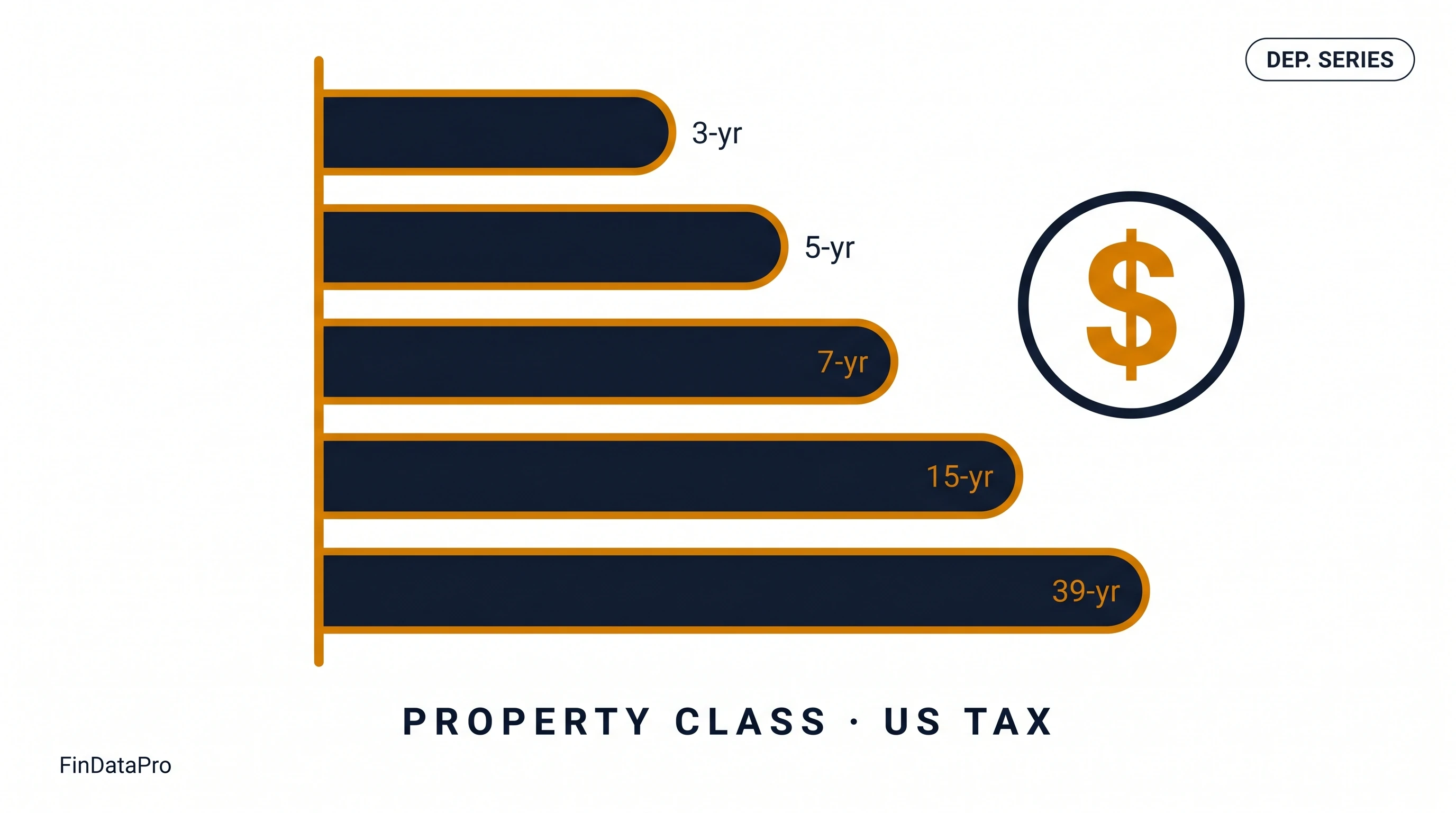
Complete guide to MACRS depreciation for US tax purposes. Property classes, half-year convention, bonus depreciation, GDS vs ADS, and worked examples.

ACA | FMVA® | 19 Years in Finance
Important note before you read further: MACRS bonus depreciation percentages change with US tax legislation. The Section 168(k) bonus depreciation rate that applied in 2022 is not the same as the rate in 2025. Do not rely on any source: including this one: for the current applicable bonus depreciation percentage. Verify current rates directly at IRS Publication 946 at IRS.gov before applying to a tax return or advising a client.
With that stated: MACRS is the US federal tax depreciation system that every international finance professional handling US subsidiaries, US private equity portfolio companies, or cross-border consolidations needs to understand structurally. Not because you will file a US tax return: you may not. Because the MACRS depreciation number in a US entity's tax footnotes affects the entity's deferred tax position, its book-to-tax reconciliation, and the cash tax modelling you are doing in your GCC or global group.
MACRS depreciation is not a formula. It is a table lookup. The IRS assigns your asset to a property class. The class determines the recovery period and the applicable percentage table. You look up the percentage for the relevant year. You multiply it by the cost basis. There is no useful life estimate. There is no salvage value. There is no declining balance calculation to perform.
Table of Contents {#toc}
- What MACRS Is: and What It Is Not
- GDS vs ADS: The Two MACRS Systems
- MACRS Property Classes
- The Three Conventions
- MACRS Percentage Tables: How to Read Them
- Worked Example: 5-Year Property
- Bonus Depreciation: Section 168(k)
- Section 179 Expensing
- Calculating MACRS in Excel
- Why MACRS Matters to Non-US Finance Teams
- Frequently Asked Questions
- Conclusion
What MACRS Is: and What It Is Not {#what-is-macrs}
MACRS stands for Modified Accelerated Cost Recovery System. It was introduced by the Tax Reform Act of 1986 and replaced ACRS (Accelerated Cost Recovery System) as the standard US federal tax depreciation method for assets placed in service after 31 December 1986.
What MACRS is:
- The mandated depreciation system for US federal income tax purposes
- A table-based system using prescribed percentages by property class
- A method that applies accelerated declining balance rates in early years, switching to straight-line when straight-line produces a larger deduction
- Governed by Section 168 of the Internal Revenue Code and detailed in IRS Publication 946
What MACRS is not:
- An IFRS-permitted depreciation method
- A US GAAP depreciation method
- A formula-based system requiring useful life estimation
- Applicable outside the US federal tax context
The separation between MACRS (tax) and GAAP/IFRS (financial reporting) creates a book-to-tax difference in every year of an asset's life. That difference is a deferred tax timing difference under ASC 740 (US GAAP) or IAS 12 (IFRS). For consolidated groups with US subsidiaries, this is a regular source of deferred tax adjustments at consolidation.
GDS vs ADS: The Two MACRS Systems {#gds-ads}
MACRS contains two sub-systems. The correct system must be identified before selecting the property class or applying any percentages.
GDS: General Depreciation System:
The default. GDS uses the 200% declining balance method (switching to straight-line at the crossover) for most personal property, and straight-line for residential rental and commercial real property. GDS uses shorter recovery periods than ADS. For most US business assets, GDS is what applies unless a specific exception requires ADS.
ADS: Alternative Depreciation System:
Straight-line depreciation over longer class lives. ADS is required (not optional) for:
- Listed property used 50% or less for business
- Any property used predominantly outside the US
- Property imported from countries with trade restrictions
- Property used by tax-exempt organisations
- Property financed by tax-exempt bonds
- Certain corporate preference items for Alternative Minimum Tax (AMT) purposes
ADS produces lower depreciation in early years and higher in later years compared to GDS. For entities required to use ADS, the MACRS percentages from the GDS tables do not apply.
MACRS Property Classes {#property-classes}
The property class determines the recovery period (how many years over which the asset is depreciated) and which percentage table to use.
| MACRS Class | Recovery Period | Typical Assets |
|---|---|---|
| 3-year | 3 years | Racehorses, certain tractor units used in road transport |
| 5-year | 5 years | Automobiles, light and heavy general-purpose trucks, computers and peripherals, office equipment |
| 7-year | 7 years | Office furniture and fixtures, most agricultural machinery and equipment, any property not assigned to another class |
| 10-year | 10 years | Water transportation equipment, single-purpose agricultural or horticultural structures |
| 15-year | 15 years | Land improvements (paving, fencing, landscaping), retail motor fuel outlets, restaurant buildings |
| 20-year | 20 years | Farm buildings (not single-purpose), municipal sewers not classified as 25-year property |
| 27.5-year | 27.5 years | Residential rental property |
| 39-year | 39 years | Nonresidential real property (commercial buildings, offices, factories) |
The 7-year catch-all: Any asset not specifically listed in a class falls into the 7-year class by default. This makes 7-year property one of the most common MACRS classes for general business equipment.
Real property: Residential rental property (27.5-year) and commercial real property (39-year) use the mid-month convention and straight-line depreciation under GDS. They do not use the declining balance rates that apply to personal property.
The Three Conventions {#conventions}
MACRS uses conventions to handle partial years. The convention determines how depreciation is calculated in the first and last year of recovery.
Half-year convention (most common for personal property):
Treats all personal property placed in service during the year as if placed in service on 1 July. Result: half a year of depreciation in Year 1 regardless of the actual acquisition date. Half a year of depreciation in the final year as well. This is why 5-year property spans 6 tax years.
Mid-month convention (real property):
Treats property placed in service at any point during a month as placed in service in the middle of that month. Applies to residential rental (27.5-year) and commercial real property (39-year). The first-year deduction varies by month of placement.
Mid-quarter convention (triggered by concentration rule):
If more than 40% of all personal property placed in service during the tax year is placed in service in the final quarter, the mid-quarter convention applies to all personal property placed in service that year. It treats each asset as placed in service at the midpoint of the quarter in which it was actually placed in service.
The 40% test and mid-quarter convention trap many taxpayers who make large year-end capital purchases. Run the test before year-end, not after.
MACRS Percentage Tables: How to Read Them {#percentage-tables}
IRS Publication 946 contains the MACRS percentage tables. The most commonly used table for personal property under the half-year convention is Table A-1. It provides the applicable percentage for each property class and recovery year.
Structure of the table:
- Rows: Recovery year (Year 1, Year 2... through the end of the recovery period plus one final year for the half-year stub)
- Columns: Property class (3-year, 5-year, 7-year, 10-year, 15-year, 20-year)
- Cell content: The percentage to apply to the unadjusted cost basis for that class and year
The percentages in the table are derived from the 200% declining balance method (for 3, 5, 7, and 10-year property) and 150% declining balance (for 15 and 20-year property), switching to straight-line at the crossover: with the half-year convention applied. You do not need to perform this calculation: the table gives you the result directly.
MACRS percentages are applied to the cost basis, not to a declining book value. The declining balance logic is already embedded in the table values. You multiply the original cost by each year's table percentage: not the remaining book value.
Worked Example: 5-Year Property {#worked-example}
Computer equipment placed in service in Year 1. Cost basis: USD 10,000. Half-year convention. GDS 5-year property.
MACRS percentages from Table A-1 (5-year, half-year convention):
| Recovery Year | MACRS % | Depreciation on USD 10,000 (USD) | Remaining Basis (USD) |
|---|---|---|---|
| 1 | 20.00% | 2,000 | 8,000 |
| 2 | 32.00% | 3,200 | 4,800 |
| 3 | 19.20% | 1,920 | 2,880 |
| 4 | 11.52% | 1,152 | 1,728 |
| 5 | 11.52% | 1,152 | 576 |
| 6 | 5.76% | 576 | 0 |
| Total | 100% | 10,000 |
Notes on this table:
- Year 1 gets only 20% despite being 200% declining balance on a 5-year life (which would be 40%). The half-year convention halves the Year 1 rate: 40% × 50% = 20%.
- The recovery spans 6 tax years, not 5, because the half-year convention produces a half-year stub in Year 6.
- Years 4 and 5 are the same (11.52%) because the straight-line switch occurred at Year 4.
- Total across all years equals 100%: the full cost basis is recovered.
Comparison to straight-line (no convention):
Under straight-line over 5 years without convention: USD 2,000 per year for 5 years. MACRS Year 1: USD 2,000. Identical numerically: but Year 2 under MACRS is USD 3,200 vs USD 2,000 under straight-line. The accelerated recovery is in Years 2 and 3, not Year 1 (because the half-year convention restricts Year 1).
Bonus Depreciation: Section 168(k) {#bonus-depreciation}
Current rates: Verify at IRS.gov. Do not rely on this or any other published source for the current applicable percentage.
Section 168(k) of the Internal Revenue Code allows an additional first-year depreciation deduction for qualifying property. The percentage has been changing as follows (subject to legislative amendment):
| Tax Year | Bonus Depreciation % |
|---|---|
| 2017–2022 | 100% |
| 2023 | 80% |
| 2024 | 60% |
| 2025 | 40% (check IRS.gov for confirmation) |
| 2026 | 20% (scheduled, pending legislation) |
| 2027 onwards | 0% (as of current legislation) |
How bonus depreciation interacts with MACRS:
Bonus depreciation is taken first, in Year 1. The remaining basis (cost minus bonus depreciation amount) then enters the MACRS table for the remaining recovery years.
Example: USD 10,000 computer, 2024 (60% bonus rate).
- Bonus depreciation: 10,000 × 60% = USD 6,000 in Year 1
- Remaining basis for MACRS: USD 4,000
- Year 1 MACRS on remaining basis: 4,000 × 20% = USD 800
- Total Year 1 deduction: USD 6,000 + USD 800 = USD 6,800
Qualifying property for bonus depreciation:
Generally, property with a MACRS recovery period of 20 years or less placed in service after 27 September 2017. There are exceptions and phase-outs for certain types. Consult IRS Publication 946 and a qualified US tax advisor for current qualification rules.
Section 179 Expensing {#section-179}
Section 179 allows the immediate expensing (deduction) of the cost of qualifying business property in the year of purchase, up to an annual dollar limit.
Key characteristics:
- Annual deduction limit: subject to annual adjustment for inflation. Check IRS.gov for the current year limit.
- Phase-out: the Section 179 deduction phases out dollar-for-dollar once total qualifying property placed in service during the year exceeds a threshold (also inflation-adjusted). Large capital expenditure years can eliminate or reduce the Section 179 benefit.
- Income limitation: Section 179 cannot create or increase a net operating loss. The deduction is limited to taxable income from active business conduct.
- Cannot be used for property used 50% or less for business, property used outside the US, or property held by a passive entity.
Section 179 vs bonus depreciation:
Both can be used in the same year on the same asset: Section 179 first, then bonus depreciation on the remaining basis, then MACRS on whatever basis remains. The order matters: Section 179 reduces the basis before bonus depreciation is calculated.
Section 179 is elective (you choose whether to take it). Bonus depreciation is automatic unless you elect out. Planning the combination of both, along with MACRS, is where US tax depreciation optimisation sits: and where the interaction with your global consolidated deferred tax position matters.
Calculating MACRS in Excel {#excel}
There is no built-in Excel function for MACRS. The calculation requires a VLOOKUP or INDEX/MATCH against a table of IRS percentages.
The approach:
- Build a reference table with property classes as columns and recovery years as rows, populated with the IRS Publication 946 percentages for each class and convention.
- In your asset schedule, use VLOOKUP or INDEX/MATCH to pull the applicable percentage for the asset's class and recovery year.
- Multiply the percentage by the asset's unadjusted cost basis.
The practical limitation:
The percentage tables differ by convention (half-year, mid-month, mid-quarter) and by whether GDS or ADS applies. A comprehensive MACRS model needs separate tables for each scenario. This is not a one-page formula: it is a multi-table structure.
For entities with US subsidiaries, maintaining an accurate MACRS model alongside the GAAP or IFRS book depreciation schedule: and tracking the book-to-tax timing differences for ASC 740 or IAS 12: is one of the more complex annual compliance calculations in a cross-border group.
DepreciationLab automates book depreciation schedules across all 7 methods: including the parallel tax calculation: so your deferred tax computation starts from accurate, reconciled numbers rather than from spreadsheets where the MACRS table may be months out of date. Try DepreciationLab at depreciationlab.org.
Why MACRS Matters to Non-US Finance Teams {#non-us}
If you are a GCC-based finance professional with no direct US operations, you may be wondering whether this post is relevant. It is, in these specific contexts:
Consolidating a US subsidiary:
The US entity's standalone financial statements will show MACRS-driven tax depreciation in the tax footnote and the deferred tax note. When you consolidate that entity into your IFRS group accounts, the MACRS deferred tax position must be carried at the IFRS group's applicable tax rate and reconciled against the IFRS book depreciation. The MACRS number is the starting point for that reconciliation.
Private equity involvement:
GCC sovereign wealth funds and family offices with US private equity positions receive K-1 or LP tax information that includes MACRS depreciation data. Understanding the MACRS accelerated depreciation in a real estate or infrastructure investment affects the cash flow modelling for the investment.
US real estate investment:
For direct investment in US commercial real estate (39-year property) or residential rental (27.5-year property), MACRS depreciation is a material cash tax benefit. Modelling the depreciation shield over the hold period requires understanding the GDS straight-line rates and mid-month convention.
Due diligence on US acquisitions:
When acquiring a US entity, the existing MACRS depreciation profile of the target's asset base is part of the day-one deferred tax liability assessment. A target with significant fixed assets that have not been subjected to bonus depreciation has a different deferred tax position than one where bonus was taken in full.
Frequently Asked Questions {#faq}
What is MACRS depreciation?
MACRS (Modified Accelerated Cost Recovery System) is the US federal income tax depreciation system for assets placed in service after 1986. It uses prescribed percentage tables from IRS Publication 946, assigns assets to property classes (3-year through 39-year), and applies conventions (half-year, mid-month, mid-quarter). It applies to the US tax return only: not to IFRS or US GAAP financial statements.
What are the MACRS property classes?
Main classes: 3-year, 5-year (computers, cars), 7-year (office furniture, catch-all), 10-year, 15-year (land improvements), 20-year, 27.5-year (residential rental), 39-year (commercial real). Most general business equipment falls into 5-year or 7-year under GDS. The catch-all class is 7-year for property not assigned elsewhere.
What is the half-year convention in MACRS?
It treats all personal property placed in service during the tax year as if placed in service on 1 July. This limits Year 1 depreciation to half the annual rate and extends 5-year property over 6 tax years (with the half-year stub in Year 6).
What is the difference between GDS and ADS under MACRS?
GDS (General Depreciation System) is the default: accelerated declining balance percentages, shorter recovery periods. ADS (Alternative Depreciation System) uses straight-line over longer class lives. ADS is mandatory for listed property, assets used predominantly outside the US, and certain other situations. GDS produces higher depreciation in early years.
How does bonus depreciation work with MACRS?
Bonus depreciation (Section 168(k)) allows an additional first-year deduction on qualifying property. It is taken before regular MACRS on the remaining basis. Current rates are phasing down from 100%. Verify the current-year rate at IRS.gov before applying.
Can I use MACRS for IFRS or GAAP financial reporting?
No. MACRS is a US tax system only. IFRS requires one of the IAS 16-permitted methods. US GAAP requires a systematic and rational method. MACRS percentages do not reflect economic consumption and are not acceptable under either financial reporting framework.
How do I calculate MACRS depreciation in Excel?
Build a VLOOKUP table against the IRS Publication 946 percentage tables for the applicable property class and convention. There is no built-in Excel function for MACRS. Reference the current-year IRS tables: not a third-party source: to ensure the percentages are correct.
Conclusion {#conclusion}
MACRS is the most prescribed depreciation system covered in this series. There is no formula to apply. There is no useful life to estimate. The IRS gives you the class and the table. You multiply. The complexity lies in knowing which class applies, which convention to use, whether bonus depreciation applies, and how all of it interacts with your deferred tax position.
For finance teams in GCC entities with US exposures, the MACRS calculation typically sits in the hands of a US tax advisor or the local US entity's finance team. What the group-level finance team needs is the ability to reconcile that MACRS number against the IFRS book depreciation and produce an accurate deferred tax computation.
That reconciliation: MACRS tax depreciation vs IFRS book depreciation, tracked asset by asset: is one of several parallel depreciation schedules that DepreciationLab is designed to automate, so the group-level deferred tax position starts from numbers that are both accurate and reconciled.
Try DepreciationLab Free → The free plan covers 10 assets across all 7 methods. Professional is $12 per month or $99 per year: a 150-asset register, bulk Excel upload, and audit workpapers.
Part of the FinDataPro Depreciation Methods Series. Related posts:
- The Complete Guide to All 7 Depreciation Methods (Pillar)
- Double Declining Balance: Formula, Example and Excel DDB
- WDV Depreciation: Income Tax Act 1961: Block of Assets and Section 32
- Free Fixed Asset Depreciation Calculator (Excel)
⚡Try It Yourself
Calculate MACRS depreciation with IRS property classes and conventions built in. Start free at Depreciation Lab →
Prashant Panchal is a Chartered Accountant (ACA) and Financial Modelling & Valuation Analyst (FMVA®) with 19 years of experience in finance, FP&A, and financial modelling across the GCC region. He is the founder of FinDataPro.
Discussion
Leave a Comment
Comments are moderated and appear once approved.